Wednesday, June 5, 2013

The Year of the Second Chance: One Down, Four to Go

My poor blog has been shamefully neglected so far this year, but that's about to change.  As I posted in the sole other entry for this year, I've labelled 2013 as the Year of the Second Chance, and identified five goals that I've started, dropped, felt bad about, and want to see to completion. I am happy to report that I have now completed one goal, and this post is about that.  I'll be doing another post soon with updates on the one that is well underway and the three that are in various states of neglect, and how I plan to turn them around, too. But for now, let's focus on the positive, shall we?  And the good news is, I have finished a marathon! The Key Bank Vermont City Marathon, to be exact.

Since I didn't actually write about the process of preparing for the marathon, I am going to attempt to do that here while also doing what I consider a public service to other newbies contemplating making this a personal goal for themselves. I am now presenting to the world (or the infinitely smaller subset of people who might read this) Ten Things Someone Should Tell You Before You Sign Up to Run a Marathon.

1. Your best asset is someone who knows what they're doing to help you. In my case, that was my astoundingly patient boyfriend, Jon.  He's a veteran marathoner (actually he even did a 50-miler two summers ago) and has encyclopedic knowledge on all things running.  He put together a training schedule for me, answered a million questions, and dispensed lots of advice, much of which I initially ignored to my peril.  A case in point was the battle over Gu. After we did a half marathon where I felt like I totally lost all my energy and will to move at mile 10.5 (just as I had in two previous half-marathons) he suggested it was really time for me to give up my resistance to Gu -- those little foil packets of energy gel.  But my vision in my head was that Gu resembles nothing so much as chocolate snot, so I continued my resistance.  Finally, on a three-hour run I tried one, and came back home demanding to know why he hadn't told me that it was actually a lot like chocolate frosting. We had similar bouts of me insisting that I really didn't need to carry a water bottle on long runs, and my old cotton sweats would do just fine in all kinds of weather.  If, like me, you insist on doing things as they might have fifty years ago and an expert is telling you differently, save yourself some time and take their advice.
At the Great Bay Half Marathon, where I still refused to learn my lesson that there might be a reason that runners eat Gu. On a side note, the hills on this course were horrible, but they did serve free beer at the end of it.

2.  If you sign up for a marathon held in the spring or early summer, that means you have to train through the winter. And if you live in Vermont, that means you have to train in a Vermont Winter.  My training started in early January for the Burlington City Marathon, which was held on Sunday, May 26. This leads me to point 3, which is...

3. You are about to become annoyingly obsessed with the weather. One thing about a training schedule is that you're supposed to stick to it.  Most people would rather chew glass than run on a treadmill for more than an hour, so for long runs especially, the weekend forecast becomes a huge deal. Don't be surprised if you start checking the forecast the day before a big run every few hours in the vague hope that the driving rain warning will have disappeared, or the expected temperature has gone up at least a few degrees.  You will spend way too much time trying to figure out whether it's better to be cold on the front end of your run, or have to do annoying things like carry your gloves or tie a jacket around your waist while running for two hours on the back end. Marathon day this year was particularly cruel. A week out, the forecast was jauntily predicting a partly sunny day in the low 60s, and then turned a couple of days out to rain, temperatures in the low 30s and wind in the 20ish mile per hour range.

4. You are also about to become equally annoyingly obsessed with your long runs. The average newbie training schedule is built around the Long Run.  Depending on the schedule you complete runs 2-4 other days a week.  Mine had me doing one run a week on hills (my dreaded Depot Street rounds, for those who live in Burlington), and a second day trying to work on speed (a very big problem for me as a very slow runner).  The big run would come on the weekend, either Saturday or Sunday, with every week supposed to build successively on the mileage of the week before.  Again, because I am a very slow runner, I would just run for time, beginning in January running for an hour and a half and working up to my longest run in early May, which was five hours.

Here's the thing about long runs: they take over your weekends.  First, you have to carve out half of a precious weekend day to do them. Then you have to make sure that there isn't a better half-day weather-wise and rearrange if there is.  Then if that half day happens to be a morning, if you're me you have to start by getting up an hour early to eat something. Then you can go back to your nice warm bed for 40 minutes or so on some frigid February morning, and have an argument with yourself about what to wear that will be warm enough but not so hot that it will make you sweaty and then freezing when you do the part of your long run down by Lake Champlain where the wind blows a lot. Then it's 1.5-4 or even 5 hours of running while you are sure that the rest of the world is either sleeping or doing really, really fun things. Finally, you're done, but not really.  Because then you are very stiff.  You will make up elaborate plans to avoid doing any activity involving going up or down stairs, and drive other people crazy by forcing them to listen to your long run stories when they make the mistake of asking why you are walking slowly or limping the day after your long run.

5.  Your second-best asset is a circle of true-blue friends and family. The fact that for roughly five months you will think that the weather and your long runs are endlessly fascinating topics that other people want to discuss for hours brings me to this point, namely that you better have some good karma going with the important people in your life. They will need to be patient, supportive, good at pretending that they care about weather and your long runs, and willing to clear their schedules the weekend of your marathon. Unbeknownst to me, Jon put together a projected schedule of when I would be passing what mile points, and worked with my very excellent friends Siham and Amanda to make sure I'd have support at a bunch of different points during the run. (He actually ran the marathon himself, in three hours and 17 minutes, then joined Siham and Amanda on the Cheer Squad).  My colleagues Katie and Sue stationed themselves at different points during the route, Siham and Amanda popped up most memorably with Jon at mile 21 and my friend and former student Annie pulled together a crew of SMC students to cheer me near the finish.
The ultimate support crew -- Siham, Amanda and Jon -- carbo loading with me at Papa Frank's the night before the marathon.

Of course nothing spells support quite so directly as this handmade Yoda doll my sister Katrinka made for me and sent from Tacoma to arrive right before the big day.

6. If you never thought about your bathroom habits before, you will now. Every subculture has its embarrassing questions that newbies need to know but don't want to ask.  In long-distance running that question is, "but what about going to the bathroom?" My favorite set of advice comes from a great running blog called Shut Up and Run.  The url is here:  http://www.shutupandrun.net/2012/05/how-to-not-crap-yourself-on-run.html
Most people I know, myself included, have found that another part of marathon training is "getting regular" -- that is trying to establish the habit for your body so you can get everything out of your body before you set out on your run.  Works for me, but I also know people who bring toilet paper and/or know where there are toilets to use on the route.  I've heard more than one story from people who missed their goal marathon time because they just had to make a pit stop.

7. Training for a marathon might actually set you back in some of your other fitness goals. I always assumed that all marathoners were ultra-fit individuals who probably ran a marathon, then turned around and swam across a lake and then maybe won some other kind of sports championship, just for fun.  Obviously, there are a lot of uber-fit athletes among marathoners, but just because you complete a marathon, that doesn't automatically translate into other forms of fitness.  In fact, what I found was that it detracted from some of my other fitness goals for two reasons.  The first is that marathon training requires the discipline of holding to the training schedule, and the soreness that accompanies that.  I couldn't do my regular cardio class at the Y on Monday mornings because I'd still be really sore from my long runs most weeks. I did try to continue rock climbing indoors at least twice a week, but other exercise often got sacrificed to marathon training.  The other problem is that marathoners start to get pretty nervous after a couple months of training about any possible injuries that could render all that training for naught.  I didn't downhill ski this year in part because of that fear, and on a rock climbing trip in Utah I'm sure I drove the whole group crazy with my slower-than-usual hiking up and down approaches to make sure I wouldn't twist an ankle or otherwise throw my training in jeopardy.

8.  It really is true that marathon training is for your mind as much as your body. I don't think I really understood this till the marathon was over.  Jon was always reminding me that long runs are partly just about "time on your feet" -- getting your body, but also your mind, used to moving for such a long distance and knowing that it can. One of the reasons I wanted to do the marathon in the first place is that I've always had major issues stemming back to being an extremely mediocre high school cross-country runner.  I just didn't think I could do it.  But the conundrum is that in marathon running, if you think you can't, you're probably right.  I was in tears the night before and again the morning of, the marathon thinking that I just wasn't going to be able to pull it off.  Luckily, my friend and veteran marathoner Patrick told me that this is normal and would fall away when the race actually began. He was right, and when I hit the 13 mile point, where the half-marathon relayers stopped, I suddenly thought that actually, I could do this. And then when I hit the twenty mile point I knew I'd be able to finish it.
Amanda snapped this picture of me on the Burlington Bike Path around mile 24.  I had been super-worried that I'd quit in the last four miles.  But lots of people told me if you make it that far, there's no way you're willing to stop then, and they're right.

9. Marathon training starts out being about injury avoidance and ends up being about injury management. Whatever underlying weakness we have in our bodies, marathon training will pick it right up.  Although Jon kept telling me to first of all try to avoid injuries, and I did try, I was relieved when our Yoga for Runners teacher, Erika, told us that ultimately, almost everyone sustains some kind of injury training for a marathon, and that continuing the training is all about injury management.  I had some knee pain and stiffness, but the thing I didn't expect was the beating that my feet took.  After every long run I'd have a big pain on the outside of my left foot and an even worse one in a bump that developed on the back of my right heel. 

10. Despite everything in the previous nine points, knowing you've completed a marathon -- at whatever pace, in whatever way you did it -- is a truly great feeling.  I highly recommend it. When I started training for the marathon, I had goals for the time I wanted to run it in, and I didn't want to take any walk breaks.  By the time of the marathon, I knew those weren't realistic, and the only goal I kept was just finishing the marathon. And I'm so happy that I did.  Something that I've come to realize is that I don't believe in perfection.  I think perfection is the enemy of action, and that we waste way too much of our lives refusing to start something or to complete it, because it's not perfect.  My sister Katrinka sometimes reminds me to "just trust the process", and on this one she was so right. If you think you'd like to run a marathon, my advice is to do it.  It takes months to train, possibly longer if you haven't run before, and it requires a commitment to stay with the process every week during those months. But here I found the words of Earl Nightingale very useful, "Never give up on a dream just because of the time it will take to accomplish it.  The time will pass anyway." If I can do it, anyone can.
Jon and me at a few minutes after I finished (he'd, of course, been done for ages). I really wanted to take a nap, but was also trying to figure out a way to get to my bed that didn't involve moving my legs and feet.
 

Saturday, March 9, 2013

2013: the Year of the Second Chance

So, I've been meaning to write this post for a couple of months now, but it just wasn't coming together in my mind.  My plan for this year is a little different than in previous years, and I've been struggling with how to think about it.  And then it hit me yesterday.  For me, 2013 is the Year of the Second Chance. (Actually, even the fact that I am writing this post on March 7 rather than January 1 tends to point in that direction).

So, why "Second Chance"? The plan for this year is to focus on five big goals.  All of them were begun previously, some in the previous years of New Things (2010) and The Challenge (2011), and some even earlier than that.  But all required a level of commitment that I just haven't been able to muster to see them through, and so they are back, like bad pennies, waiting for a real plan to get them to completion.  Here's the list of goals and why to me they represent Second Chances:

1.  Become a Better Rock Climber. When I was in high school and college (in southern Idaho and northern Utah respectively) I had barely heard of the whole idea and definitely knew it had nothing to do with me.  But during the year of 52 New Things, from the first time I tried it (in a climbing gym in Nepal, of all places) I was suprised at all much fun I thought it was, and now I'd actually like to work on getting better at it.  The amazing Saint Michael's College Wilderness Program gave me my big Second Chance on this one, and on Saturday I'm headed back to Utah to have the spring break I never did when I was an undergrad at Utah State University.

I have lots and lots of people to thank for taking me climbing and giving me lessons, but probably the biggest thank you goes to Amanda, who graduated in 2011 but has stuck around Burlington to do outstanding work in combating gender-based violence and also coach her former professor on rock climbing.

2.  Run a Marathon. I imagine this one's on lots of people's life lists, and I had big plans to do it during the Year of the Challenge in 2011. But a mishap on an ill-advised run well above my pay grade at Mad River Glen that year put an end to it when I ended up on crutches.  This year, the gods smiled on me again, first by having one of my best friends and fellow New Thing/Challengista, Siham, decide that this was the year we must do a marathon.  Though it's now an open question whether she's still going to be able to complete the training with everything else on her plate, I also lucked out in finding the best possible personal coach in my boyfriend, Jon.  He's a lifelong runner and veteran of several marathons and even a 50 mile trail race, and a font of wisdom in all things running-related.  So, this is the year.  I'm signed up for the Burlington City Marathon, following Jon's  training schedule with a minimum of whining, and hoping and praying that I can finish 26.2 miles.
Jon's a good multi-tasker.  He's my boyfriend and my get-me-through-my-first marathon coach. Here he is showing me how far he expects me to run on our last day in of our recent quick trip to Puerto Rico.
 3.  Become a Better Ice Skater. When we were in elementary school in Michigan we skated on our pond and I loved it.  On and off over the years I've taken a few lessons, but something always seems to come up just when I'm starting to get a few more advanced skills.  This is the year I want to stop making excuses and make the transition to actually stringing some of those things I've learned into a sequence I can do all at once. 

4.  Finish a draft of the Millennium Development Goals Book. This is another project begun in the year of the Challenge that I managed to grind to a halt when I headed out to Jordan for the year.  Right now I'm doing an independent study with four students, one of whom was on the original student team, and we're getting a few chapters, as well as the case studies into draft form.  After that we'll be seeing if any of the other original writers can come back in for some more writing work. 

5.  Learn to Speak and Read French. I took French in 9th and 10th grades in high school, for two semesters in college, and as an audited course at Saint Mike's.  I seem to be permanently in an Intermediate French class cycle, but my hope is to use summer and fall as a time to focus more academically on goals 4 and 5.  Though Siham doesn't know it, she is part of the plan, because she is going to agree to correspond with me in Facebook in French as part of my regular practice.

When I picked these goals for 2013, the plan was to work on them all simultaneously, but in a matter of weeks I learned that was basically impossible.  So, the current working plan is to try to keep them all at least minimally in play, but focus on different ones at different times.  The order of the goals above is roughly in line with the new chronology. Each goal has some kind of built-in deadline or event to test my progress, beginning next week (March 9-16), when I head to southern Utah for a week of outdoor rock climbing with the Saint Michael's College Wilderness Program.  After that, the Burlington City Marathon is May 26.  There is a built-in deadline for a draft of the Millennium Development Goal book in that I am teaching the course that will be using it in the fall, so it has to be completed so we can use it as a text and also critique it.  French will be a focus in the fall, and will culminate in a week or weekend in a French-speaking place.  I'd like to reach my figure-skating goal in December, but still need to figure out exactly what form that would take (figure skating friends, I'm open to suggestions!).

The plan for the newest incarnation of the blog is to help keep me accountable and on-track with these goals.  I plan to write a post at least twice a month, with a focus on one or two of the goals and at least a brief statement on where the others are at.  I've talked to a lot of people who helped me out in the original Year of New Things and Year of the Challenge, and many of them have goals of their own that they're working on this year.  So, I'd like to make a request that if people have their own goals, that they write in on this post and list them, and also use the blog (or their own) as a way to keep track of their own progress.  And of course, anyone who is sharing one or more of the specific goals listed above, by all means, let me know so we can figure out how to do some work on them together.

Sunday, November 18, 2012

Jordan Challenge 39: Remembering the Red Sea Dive

For months I've been meaning to write this post.  It's the very last challenge I did before leaving Jordan, and it makes no sense that I didn't write about it the week I got home, or the next week.  But I didn't. I think on some level I knew that writing it was acknowledging that my year in Jordan had ended and my life in Vermont had picked back up again.

Something's changed, though, and now I felt like writing the post, and I think it's because my excellent Fulbrighter friend Grace recently came to spend the weekend in Vermont.  Grace was a part of many of the adventures I posted about last year including our Christmas-y Madaba excursion; my first trip to Beirut; our Wadi Mujeb wet hike; camping at Dana Nature Reserve; and perhaps most memorable of all, our trip to Cairo. Throughout the year last year I annoyed my fellow Fulbrighters to the point of distraction by insisting that not only was Vermont the best state of the Union, but that Camel's Hump was quite possibly the best place in that best state. So when Grace yielded to my arm-twisting and agreed to come see Vermont for the very first time, it was only obvious what hike we needed to do. An additional bonus came when my friend and former student Alexsis decided to come for a visit as well, with her roommate and friend Meghan in tow.  (Alexsis has participated in plenty of other projects on this blog as well, including among many others, a trip to Jordan, the West Bank and Dubai; snowshoeing at night; and helping me become a better skier in winter 2011).

Grace, Meghan and Alexsis all agreed with me that this bench near the beginning of the trail was pretty cool.

Alexsis, Meghan and I on the top of Camel's Hump complaining only a little that it seemed pretty snowy for early November!

So, I think Grace has helped me accept the fact that it's past time for me to fully reorient my life back to living in Vermont.  I'm going to do this final post, and after this I'm going to move into my new blog project for 2013 (and the part of 2012 that's left), which for now I'm calling Focus on Five.

But before that happens, here's a short story and some pictures from my final adventure in Jordan, doing a "try dive" complete with a scuba tank in the Red Sea.  Grace and I had agreed that we'd squeeze this one last experience in before I left the country and her office colleague and friend, Lucy decided to join us for good measure.  Because we didn't have time for a full-fledged (or even a half-fledged) course, we opted for the baby version, a "try dive".  In this version, the dive master cuts straight to the chase and runs through the most basic of basics -- mainly what to expect in wearing a tank and how to communicate via hand signals under water. Thus oriented, we strapped on our weights and surprisingly heavy tanks and other gear and explored a coral reef with the luxury of breathing under water.  Because there is so little instruction beforehand, in a try-dive the dive instructor literally leads his or her charges by the hand (and never lets go).  Grace and I swam on both sides of one instructor, and Lucy swam with the other one.

Most important sign we learned: I'm not drowning (yet).
 
Pulling off my diving shoes at the end of our try-dive adventure.
 
Everything about the experience under water was amazing.  The red sea coral reef was alive with a huge array of colorful tropical fish, corals and sponges.  It really was like visiting another planet where the atmosphere was completely different, and the movement was so much more three dimensional than ordinary life.  At one point I thought about the fact that this reef might, like so many others, be killed by our human activities that are destroying the oceans, and it just felt so incredibly tragic.  How could we destroy such a beautiful alternative universe?

Lucy checking out the coral at close range while snorkeling

Grace and I attempting (badly) synchronized snorkel-swimming for the camera.

After the dive was over, we were allowed to keep our fins and masks, and given snorkeling equipment so that we were able to pass a good chunk of the day snorkeling around the same reef that we had done our dive in.  Grace had a waterproof camera, so we were able to take some pictures then as well, though they didn't really do justice to what we had experienced previously.

Spending my last weekend in Jordan in Aqaba, the only seaside town in an almost entirely landlocked country, was a great way to experience one last facet of the fascinating country that was my home for ten months.  Doing it with my friend and fellow intrepid explorer Grace made it that much more outstanding.  And now that Grace has been to Vermont and started to explore the wonders of my chosen permanent home, it feels like the pieces are starting to settle into place.  I've been reminded that the world is full of amazing places and friends we haven't met, but who when we do, have the potential to become lifelong fellow explorers of still more exciting new and returning destinations.  It's great to reminisce and exciting to look forward and imagine what might lie ahead.

A perfect reminder that life is always changing, and that there's nothing wrong with that.  Grace and I, posing with Lucy in front of the Red Sea in Aqaba, Jordan in June, 2012...
 
...and less than six months later, Grace and I standing with Alexsis at the trail head to Camel's Hump in Vermont.  Halfway around the world, still having adventures with great people in great places.
 

Saturday, August 18, 2012

Jordan Challenge 38: A Whirlwind Tour of Istanbul

I'm back in Vermont now, and my experience as a Fulbrighter in Jordan has been done for some weeks.  In fact, Ramadan has come and gone during the time that I've been back, and having my Jordanian friends write on the occasion of Eid has got Jordan front and center in my brain again. It's reminded me that I got to have a few more fabulous adventures before I left the Middle East, and I wanted to write about them before any more time had passed.  One of these adventures was visiting Istanbul with my wonderful friend and fellow Fulbrighter, Elizabeth.  We only had a weekend to do it, and therein lay the challenge.  For as we realized, Istanbul is a world-class travel destination, and absolutely jam-packed with amazing things to see or do. 

If you're going to Istanbul, my first piece of advice is to learn from our experience and give yourself much more than a weekend to begin with.  But if, like us, a weekend is what you've got to work with, my second piece of advice is to do with we did, and seek help from others who have been.  My friend and former student Alexsis is not only an impressively intrepid Middle Eastern traveller, she also lived in Istanbul for a semester.  Elizabeth and I were grateful to her for her exquisitely detailed written suggestions.  And so, to pay her good deed to us forward, here are some suggestions for others of some of the phenomenal sights and experiences of Istanbul.

1. Istanbul has perhaps the most intriguing position of any city in the world, It literally sits on the line between two continents, and figuratively defines the edge between East and West.  Where else in the world can you take a boat ride with Europe on one side of you and Asia on the other, or have the first site along your tour be the Aghia Sophia, still bearing traces of having been both a mosque and a church of great renown? The most fascinating places in the world are the ones that bring cultures and even civilizations together, and nowhere I've ever been (except maybe Stonetown on Zanzibar) does it with such a punch as Istanbul.

A must-do activity in Istanbul is to take a ride on one of the many ferries plying the waters of the Bosphorus and allowing tourists to stand on the deck of one boat to look at two continents.

A view from inside the Aghia Sofia.  Once a Greek Orthodox basilica, then a Roman Catholic cathedral, then an Islamic mosque and now a museum, the interior bears signs of all these previous uses.


2.  Istanbul is a feast for all five senses.  Feed them all while you're there. Like any other amazing tourist city, there's so much to see, but there's also music and dance, the sound of the call to prayer from the huge mosques, and so much good food to taste and smell -- from the scent of roasting kebabs everywhere to tantalizingly beautiful trays of sweets in shop windows to apple tea that I came away addicted to drinking.
I was sorely tempted to buy a lamp, not least because I loved passing the lamp shops at night and seeing the glorious and gorgeous patterns they made in the dark.

As in Jordan, there seemed to be a sweet shop on every corner, selling the most beautiful and delectable sweet treats, only in Turkey you can also get Turkish delight, which most Americans only vaguely remember reading about in The Lion, the Witch and the Wardrobe.

At dinner our first night, Elizabeth and I were overwhelmed by not only the taste of the food but also the brightness of colors of everything on our plates.

The only thing better than Turkish food is getting to eat it several stories up at an open-air restaurant overlooking the water.

3.  In some places, the tourist meccas really are all they're cracked up to be.  Most major cities have a particular area that is prime real estate for tourists, and in Istanbul, that is Sultanahmet.  And inch for inch, I don't think I've ever been to a place that has so much of interest to outsiders crammed into a space. I was warned by locals and previous tourists alike that some visitors never get outside Sultanahmet at all, and having visited and stayed there, I can see why.

This was my favorite unexpected sight in Sultanahmet, the basilica Cistern.  It doesn't look like much at all from the outside, then you go down underneath to this amazing dark cavern full of partially lit columns, strange carvings and schools of carp swimming in the water that fills the floor of the cistern.  It's very beautiful and other-worldly.

A magnificent park and promenade, composed partly of the old Roman Hippodrome, separates the Aghia Sofia from the Blue Mosque.  It's open to the public (except, of course, during prayer times) and makes a great companion stop to the Aghia Sofia.
The Disney-esque front entrance to Topkapi Palace doesn't begin to do justice to what it's in store inside.  The complex is simply enormous, and was home to a long line of Ottoman Emperors and their harems. A visitor could easily spend multiple days inside taking in all the buildings and exhibits of life behind the walls of the palace throughout the centuries.


Islamic art doesn't show people or animals, but one of the things it does feature is intricate geometric patterns and designs.  This room was part of a library, and the walls were panelled with all kinds of differently-patterned tiles.  The three vertical dark shapes here are actually a set of special shelves cut into the wall to hold turbans.

4, I'm not a big shopper but...anyone who is will never find a better place to explore.  First, there is the famous Grand Bazaar where one can everything from high end imitations of designer bags to housewares of all kinds. Then there is a spice bazaar and sweet shops selling delectable pastries and Turkish delight. Istanbul is also crammed with carpet shops selling -- of course -- Turkish rugs.  Anyone who knows me well, particularly my sister Katrinka, who begins any shopping trip we make together by asking me how many minutes I will be able to tolerate being in the store (true story), will be shocked to learn that I voluntarily spent an entire morning in a rug shop, while Elizabeth and I each bargained our way towards buying our very own Turkish rugs. After three rounds of apple tea, two narrowly-avoided walkouts, and several viewings of photos of the shop's famous carpet customers (including our favorite, a young Donald Sutherland in geeky walking shorts and black socks), we both walked out with our very own rugs, packed to an astoundingly compact size in their special little cases with handles.

The nephew of the shop owner fell in love with Elizabeth instantaneously.  I'm pretty sure if she would have just accepted any of the hundred marriage proposals he made in the course of our morning's bargaining, she could have negotiated a better discount for both of us.  But sadly, she decided that the life of a rug vendor was not for her, and that particular bargaining avenue went untapped.

It was so much fun to watch the masters at their work.  We would mention a particular color or design, and suddenly there would be five variants unrolled on the floor, each with its own story, village of origin and proof of some aspect rendering it uniquely desirable.

5. Just go! This was the last international trip of my time in Jordan.  When Elizabeth and I booked our tickets, waning budgets, diminishing days left in the country, and competing priorities were all conspiring to suggest that we might need to forgo it.  But we threw caution to the wind, and went for the weekend, and it's one of the best decisions I made in my ten months in the Middle East.  It was also a lasting reminder of a truism that takes many forms.  Basically, there are always a million reasons not to travel -- not enough time, not enough money, work needs to be done, something in our daily routine might suffer.  We can live our lives letting these excuses make our decisions for us, or we can just go.  Istanbul is my lasting reminder in favor of the latter choice.

The view of the Bosphorus from the backside of one of the grand buildings within the Topkapi Palace compound.

Sunday, July 29, 2012

Eight Things I Wish All Americans Knew About Palestinians


For ten months of the last year I lived in Amman, Jordan as a Fulbright Teaching Fellow at the University of Jordan.  During that time, and in two previous short research trips, I met not only Jordanians but also ethnic Palestinians living in Jordan – some with Jordanian citizenship, some without – and Palestinians who were living in the West Bank and Gaza. I also had the opportunity to visit both Israel and the West Bank on several occasions, and to see for myself many of the issues at play – in Jerusalem, in the Israeli cities of Tel Aviv and Jaffa, and in the West Bank areas of Bethlehem and the South Hebron Hills.  My experiences left me with a strong belief that there will never be peace between Israelis and Palestinians, and in the Middle East more generally -- where the status of the Palestinians is a perpetual  political question-- unless and until the legitimate grievances of the Palestinians are understood,  acknowledged and addressed.

 It also seems to me that one of the major stumbling blocks to even opening up that conversation is that most Americans know very little about the Palestinians, or the nominally-Palestinian land upon which many of them live under military occupation by the Israeli Defense Force (IDF). To make matters worse, Americans are often offered only the Israeli perspective on issues regarding the Palestinians.  There is little to no  reporting in the American press about the conditions that Palestinians are subject to in the occupied Palestinian Territories (oPT), the non-violent campaigns --including, several months ago the largest and longest prison hunger strike in history  – that Palestinians have launched to try to change their circumstances, nor the violence done to Palestinians by not only soldiers of the occupation, but increasingly and with impunity, settlers living on Palestinian land they have appropriated.

This essay is my own attempt to challenge my fellow Americans to learn more.  Some people may read what I have written and disagree with either the facts as I have presented them or the context.  While I do not claim to be an expert, I have had many more opportunities than the average American to talk to Palestinians (as well as Israelis and Jordanians who are their neighbors) and to see first-hand many of the manifestations of the occupation in the West Bank and in Jerusalem.  I hope what I have written here will not be the last word on the subject, but an opening for much more discussion and debate.
Here then, are eight things I wish all Americans knew about the people we refer to collectively as “the Palestinians”.

1.        Who the Palestinians are. One of the first things I’ve realized when talking to students and others, is that people in the United States are often not quite sure who, exactly, the Palestinians are. They often erroneously  associate the mere word with the word “terrorism” or with conflict with Israel.  Republican Presidential candidate Newt Gingrich got a few headlines last year with his remarks that Palestinians don’t actually exist, but of course they do.  By Gingrich's logic, Canadians  and Americans as former parts of the British Empire are also "invented peoples" and equally undeserving of their own states. Palestinians are the descendants of the culturally and linguistically Arab people who lived in what are now Israel and the occupied Palestinian Territories  at the time that Israel became a state recognized by the United Nations in 1948.
On a personal note, I have been told by some of my American students that they've never met a Palestinian, so I couldn't resist introducing two of the most wonderful Palestinians (and people in general) anyone could ever hope to meet.  In the top photo is Shamo, who works with Friends of the Earth Middle East - Palestine office.  Here she is taking my former student Kate around the Church of the Nativity in Bethlehem, her hometown.  When Shamo heard that Alexsis, Kate and I were staying in a hotel during our 2010 research trip she insisted we move to her place and took us all over the region to look at projects of Friends of the Earth and meet with local Palestinian villagers.  The second picture is of my fabulous student Mary (wearing blue), sitting with her equally fabulous Health, Environment and Human Rights classmate, Noura.  Mary is a Palestinian from the Gaza Strip.  She and her twin brother earned scholarships to attend the University of Jordan, while the rest of her family still lives in Gaza.  Mary is passionately devoted to human rights and development for everyone, and through her patient and thoughtful answers to my questions I learned a great deal about the lived experience of Gazans under the occupation.


2.       Why there are so many Palestinian refugees. Part of the reason that the term “Palestinian” is perhaps tricky for Americans to wrap their minds around, is that most people would agree that Palestinians operate in that  conundrum of being what political scientists refer to as a “nation” without a state.  Very broadly speaking, when Israel was granted statehood by the United Nations the area known as Palestine was partitioned into Arab and Jewish states, with Jerusalem being designated an “international” city.  The countries of Jordan, Egypt, Iraq and Syria did not accept this and attacked Israel. Israel won the war, but in the process, hundreds of thousands of Palestinians were pushed out of Israel into what are now called the occupied Palestinian Territories of the West Bank and Gaza or into neighboring countries, and forced into refugee status. This war is seen by Israelis as a war of independence and by Palestinians as the “Naqba” (the Catastrophe).   

  A series of peace treaties left the areas now known as the West Bank and Gaza under the control of Jordan and Egypt respectively.  However, in 1967, the Israel launched a pre-emptive war against Syria, Jordan and Egypt (referred to in Israel as the Six-Day War).  In this war, Israel took the areas of the Sinai Peninsula and Gaza from Egypt (they later returned the Sinai to Egypt as part of the Camp David Accord), the West Bank and Jerusalem from Jordan and the Golan Heights from Syria.  Many Palestinians in these areas were again pushed out, creating a second wave of Palestinian refugees. The UN agency that deals with Palestinian Refugees, UNRWA (United Nations Relief and Works Agency), defines refugees as "people whose normal place of residence was Palestine between June 1946 and May 1948, who lost both their homes and means of livelihood as a result of the 1948 Arab-Israeli conflict." But even in their own work with the 58 official refugee camps in Gaza, the West Bank, Jordan, Lebanon and Syria, they acknowledge that ten of the camps had to be constructed after the 1967 conflict. When it started in 1950 UNRWA estimated that it served around 750,000 Palestinian refugees. Today there are almost 5 million official Palestinian refugees qualifying for their services, with about one-third (1.4 million) still living in the camps that were set up back in 1948 and 1967.

Almost four million Palestinians still live in the occupied Palestinian Territories, but the majority of ethnic Palestinians live outside of them.  About five million Palestinians live in Arab countries, 1.2 million live inside of Israel (most are citizens and are known as “Palestinian Israelis” or “Arab Israelis”) and 0.6 million live in other foreign countries. 

3.       Where the West Bank, Gaza and East Jerusalem are. When we speak of the occupied Palestinian Territories, we are talking about two pieces of land separated from each other. The West Bank refers to land that is on the western side (bank) of the Jordan River.  The Gaza Strip is literally a strip of land that used to belong to Egypt and now borders it.  As the map below shows, Jerusalem sits on the border of Israel and the West Bank.  In the UN separation in 1948, West Jerusalem went to Israel and was about 38 square kilometers.  The remaining East Jerusalem is only about 6 square kilometers.  Following the 1967 war Israel annexed an additional 70 square kilometers from the West Bank to add to West Jerusalem. The West Bank is home to approximately 2.5 million Palestinians, the Gaza strip 1.6 million and East Jerusalem  0.2 million.

Here is what these areas look like:

In the very simple map above, the Palestinian Territories are in orange, and one of the problems of creating a state for the Palestinians from them becomes immediately obvious – they are not connected and there is a travel ban in place between Gazans and people who live in the West Bank.  The map also demonstrates how small the Gaza strip actually is, which demonstrates one of the great hardships of the Palestinians.  In that small strip of land live over 1.6 million people, making it one of the most densely populated places on the planet with almost 10,000 people per square mile. During periods of siege, the borders to Israel and Egypt and the shoreline have all been tightly controlled, making trade, travel and basic services such as water, electricity and waste disposal difficult to impossible for the people trying to live normal lives there.

4.       What the Occupation is. As noted above, the Gaza Strip, West Bank and East Jerusalem are all referred to as “occupied territories” because they are under the military control of Israel.  Technically, there is controversy on this point.  Israel actually considers East Jerusalem part of Israel because it annexed it when it annexed the additional part of West Jerusalem in 1967.  Although the Israeli Supreme Court has upheld the annexation of East Jerusalem, and Israel does  not grant Palestinians in East Jerusalem full citizenship (they are only “permanent residents”), no other country in the world has recognized this annexation. The Gaza Strip is also technically no longer under occupation because Israel withdrew its troops and all its settlements in 2005.  However, all the borders of Gaza, including its coast and airspace are totally controlled by Israel.  Finally, the status of occupation of the West Bank was made more complex by the 1993 Oslo agreement.  Under the agreement, the West Bank was divided into Areas A, B, and C.  Both security and administration in Area A is controlled by the Palestinian Authority.  The Palestinian Authority has administration over Area B, but Israel has all security authority and Area C is totally controlled by Israel.

  Below is a map showing the areas, with Area C in brown.  In all, 61% of the West Bank is Area C (completely controlled by Israel) and only 18% is Area A (under complete control of the Palestinian Authority).


5.       What a settlement is. The term “settlement” refers to civilian Israeli communities that have been built in the Occupied Territories.  Currently, there are settlements in the West Bank, East Jerusalem and the Golan Heights.  According to international law (specifically the Fourth Geneva Convention) settlements are illegal, and this position has been confirmed by the International Court of Justice and most recently, a 2012 statement by UN Secretary General Ban-Ki Moon.  Israel has rejected these ideas, and there are currently about 120 settlements formally supported by the Israel government and dozens more “outposts” not formally recognized by the state.  The 1993 Oslo Agreement included a promise by Israel to freeze settlement activity, but since 1993, the settler population has grown from some 116,300 to 289,600 in the West Bank and from  152,800 to more than 186,000 in East Jerusalem according to former US Ambassador to Israel Daniel Kurtzer.

The settlements of the West Bank comprise much of Area C and are connected with roads that may be accessed only by settlers and other Israeli citizens.  Israel has built these roads, but Palestinians cannot use them. Although the development of official settlements continues apace, and all the settlements sanctioned by the government of Israel are provided  with roads, electricity and running water, the Palestinians living in the neighboring areas cannot access any of these resources, and in fact must petition the state of Israel to build this infrastructure for themselves.  These petitions are routinely denied, and I have personally visited Palestinian villages (in May, 2012) where people live in tents (because they are not allowed to build permanent homes), have no running water or electricity (because they are not allowed to create these systems, even to use them in their tents) and have had their wells sealed by the IDF so that they have no choice but to go to the nearest Palestinian town to buy water at ten times the cost of what is charged within Israel.

One of the tasks of the occupying  IDF soldiers is to protect the settlers from the Palestinians.  However, the opposite is not true, and the IDF is neither trained nor ordered to protect Palestinians from Israeli settlers, who can and do harass and violently attack Palestinians and their property and crops.  One notorious example is Hebron, which was a Palestinian community of 35,000 when a settlement of 800 Israelis purposely located itself in the city center, and IDF forces instituted severe restrictions on Palestinian movement and commerce.  According to a report by two Israeli human rights groups, B’Tselem  and the Association for Civil Rights, between 1994 and 2007, thousands of Palestinians were forced to leave and 1,829 Palestinian businesses went under. The remaining Palestinian community has attempted to keep its marketplace alive, under extreme duress from settlement residents who live in housing that is literally above the marketplace. The merchants have been forced to erect a “roof” of chicken wire over the market to shield themselves from the garbage that is hurled at them from the settlement housing above.

6.       What the separation wall is. The separation wall (referred to as the “Apartheid Wall” by Palestinians) was begun ten years ago, with Israel stating that it would serve as a security barrier against Palestinian acts of terrorism aimed at Israeli civilians.  However, the route of the wall (not all of it has been built yet) is not along the line demarcating Israel and the West Bank.  It is more than twice the length of the Green Line (the recognized border between Israel and the West Bank), and 85 percent of it actually lies within Palestinian territory, taking about 8.5% of land that is part of the West Bank.  Included in the additional land are many of the settlements referred to in the previous point, farmland belonging to Palestinians and water sources.

The Separation Wall is also responsible for the creation of “seam communities”, which are Palestinian communities trapped between the Green Line and the Separation Wall.  The people of these villages are entirely enclosed behind the wall and can only go outside of it through small gates manned by IDF soldiers who determine when the gates are open.  If their farmland is outside, they must bring all their farming equipment in and out of the gate every single day.  They can harvest only when the gates are open, and their work day is determined not by their needs, but by soldier decisions of when to open gates.  The same is true for school children who travel in and out, and for people having medical and other emergencies.

7.       What all of this means in the day to day life of Palestinians.  The combined presence of the occupation, the settlements and the separation wall come together in mutually-reinforcing ways that conspire to make everyday life miserable, dangerous and impoverished for the Palestinians. Here I list just a few of the many things I learned about or saw for myself in the last three years:

*Restrictions on movement. One of the most devastating impacts for Palestinians in their daily lives has been restrictions on their movements  in large and small ways.

 Israel closed both Palestinian airports (one in Gaza, one near Ramallah) in 2001, so Palestinians can only fly to other areas of the world via Jordan or Egypt.  This, of course, assumes that they can go to Jordan or Egypt, which requires permission from Israel to cross the borders.  I’ve crossed between Jordan and the West Bank at the single border crossing open to Palestinians on four different occasions.  Palestinians are processed separately from non-Palestinians, are transported on separate buses (no one is allowed to take their own cars over the border), and I’ve personally witnessed the humiliating and arbitrary treatment that Palestinians face in simply trying to enter or leave their own homeland.

Within the West Bank is a dual road system.  Settlements are connected with well-maintained, direct roads which settlers may use freely.  Palestinians are relegated to circuitous, poor roads littered with temporary and permanent checkpoints.  The ability of Palestinians to pass through the checkpoints, like their ability to go through the security wall, is at the discretion of the IDF soldiers who staff them.  As a result, for the Palestinians everything takes longer and is less predictable.  A trip that would take an hour for an Israeli settler might take three for a Palestinian living in the same area.  Or it might not happen at all, if a checkpoint is closed or passage is denied.

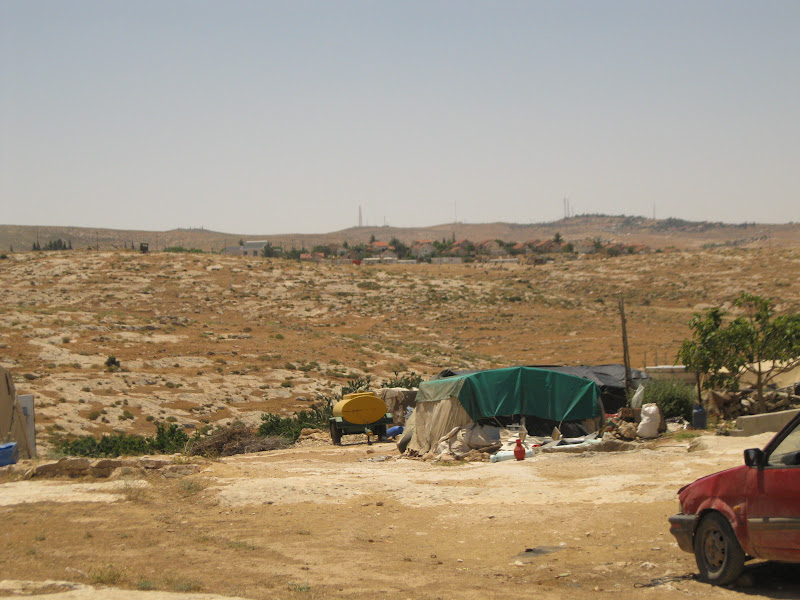
*Home demolition. The Israeli Committee Against House Demolition (ICAHD) estimates that since the occupation began in 1967 approximately 26,000 Palestinian structures have been destroyed by Israel.  In recent years, approximately a third of these have been homes. There are three general categories of home demolition: punitive (6%), administrative (23%) and military (47%) Punitive home destructions are done as punishments to people associated with the household for actions ranging from attacking Israelis to political organizing.  Although this policy is seen as a deterrent, studies have shown that home demolitions generally result in more violence (including suicide bombers) not less.  Administrative demolitions are carried out against Palestinians who did their constructions without legal permission; these homeowners are trapped in a Catch-22 nightmare, however, since in Area C, 94% of all building permits submitted by Palestinians are denied.  Finally, military demolitions are carried out by the IDF as a means of clearing land for a stated military objective.  In the past week, for example the Israeli Defense Minister has ordered the demolition of 8 villages in the South Hebron Hills for the sake of Israeli Defense exercises.  I visited several of these villages in May.  Some of them are actually tent cities, because the residents have been unable to get permits to build houses there, although the nearby settlements (which share the same land area but will not be cleared for the sake of the same military exercises) have had no problem building homes or having Israel provide them with roads, electricity or water.
In the two pictures below you can see one of the many structures that is now slated for demolition within this tent village. Note the mobile water tank that the village takes to the nearest town to pay to have filled.  Behind these are the Israeli settlement, which you can see more clearly in the second photo.  Although, as the first photo illustrates, they both occupy the space that the IDF has deemed necessary for military exercises, only the tent village will be demolished.


*Incarceration. As of June 2012, there were almost 4500 Palestinians incarcerated in Israeli prisons.  Of these 285 were under administrative detention, a policy that Israel has allowing a Palestinian to be arrested without any charge and held for any period of time at all. There are also about 200 Palestinian children in detention, most of them prosecuted under the military law used against Palestinians in the Occupied Territories. A large proportion of them were convicted for stone-throwing, an activity which is also performed with impunity by settlers of the same age who target Palestinians walking byAccording to a report released by Friends of Humanity International in 2011, the Palestinians are the most incarcerated people in the world, with over 40% of Palestinian males having experienced detention at some point in their lives.
In 2012 incarcerated Palestinians went on the largest and longest prison hunger strike in history. Some of the strike leaders had fasted for over two months' time, and over 1,600 prisoners fasted for a full month until the strike ended in negotiations with Israel in mid-May They were protesting the policies of administrative detention, extended solitary confinement, and denial of visitation of family members for prisoners from Gaza.  I was living in Jordan during the strike, which was widely discussed (and supported) by my Jordanian students and colleagues.  When I tried to discuss it with my friends in the US, most had heard nothing at all about it.  

*Water. This is one case where the numbers speak volumes. Daily per capita water use in the West Bank is 73 liters (the World Health Organization sets the minimum a person should have at 100), and  Israelis (including residents of the settlements) consume three and a half times this amount daily. In Gaza, the situation is even worse; a 2010 report issued by the UN Environmental Program (UNEP) and various NGOs found that fully 95% of the water in Gaza is unfit for human consumption.  This is due in part to the siege on Gaza begun in 2007 that prohibited the importation of materials needed to fix and maintain the water and waste water treatment facilities there.  Though the siege has eased, the ban has been maintained.

The inequalities in water are immediately apparent to visitors to the West Bank.  Driving down a road open to foreigners (but not Palestinians), one sees settlements with not only running water but landscaped yards and swimming pools next to Palestinian villages with primitive dry wells.  Under the Oslo Agreement (which was supposed to be a temporary framework), all Palestinian water projects must go before a board that gives Israel veto power.  In interviews I conducted with two students in summer 2010, we learned that the fact that Israel almost always vetoes proposed water projects makes donor countries unwilling to support them as well.  The Separation Wall has made the situation worse, bringing numerous above and underground water sources over to the Israeli side of the wall and driving Palestinian farmers reliant on these water sources out of business.  When their land goes fallow because they cannot water it, it becomes subject to seizure by Israel, which claims the right to any land not being cultivated by Palestinians.
The picture below shows the water source of a tent village we visited in the South Hebron Hills.  Though it always went dry in the summer, the water is now completely unusable because the IDF crushed and threw a block of rusted metal into the well so that people would not be able to drink the water in order to enforce a ban on developing water sources in the area.


*Economic and human development. Not surprisingly, the impediments to movement, demolition of homes and seizure of land, deprivation of water and other fundamental abuses of rights that occur daily under the occupation have devastated the economy of the occupied territories.  The areas are legally and logistically unable to develop infrastructure – roads, airports, water and sewage treatment, communications networks – to connect Gaza and the West Bank, the Territories to the outside, or even communities within the regions.  Farmers and manufacturers must compete with subsidized settlements that have not only the benefits of water, government-provided services like electric lines and roads, and the provision by the government of the land itself, but also the ability to farm and manufacture under conditions of their own choosing.  In addition, the settlements can take advantage of the cheap labor of farmers who have lost their own land and must now make the choice of working on the settlements or living in abject poverty.  Under such conditions it is hardly surprising that according to Palestine's 2010 Millennium Development Goal Progress Report, 34% of Palestinians live below the national poverty line -- 23.6% in the West Bank and 55.7% in Gaza.  Even these numbers are kept artificially low by humanitarian assistance.  If this assistance were withdrawn, the poverty levels would be estimated to rise to 45.7 in the West Bank and 79.4 in the Gaza Strip.  The same report notes that food insecurity, is also high, with 25% of those in the West Bank and 61% in Gaza qualifying as food insecure, while unemployment has doubled since 1999.

8.       Ways to be a part of the solution.  This post has already gone far longer than I ever meant it to, and so, instead of writing another lengthy section, I will close very briefly by saying that there are many, many organizations and information sources for people interested in learning more and contributing to a just and lasting solution that will benefit both the long term interests of Palestinians and Israelis.  Rather than trying to create a list, I will mention and thank the two organizations most responsible for igniting my own interest and further research on these issues, Friends of the Earth Middle East and Breaking the Silence.  The groups are very different, but they both have inspirational founders, courageous staff and volunteers, and visions for change grounded in educating larger publics about the ways in which current policies are systematically denying the rights of Palestinians and making lasting solutions to shared problems an impossibility. These groups, and the Palestinian friends and their supporters who I've met in the past three years inspired me to learn more and speak out on behalf of injustices that are happening every day.  There is a wide spectrum of opinion among Palestinians, Israelis and their allies about the best means of finding lasting solutions to the problems outlined here (and others that I've left out). But a first step, I would argue, is to ensure that all voices are heard, and particularly those Palestinian voices that have not been heard, especially in the United States, though these issues affect their lives and futures most directly at all.