Monday, June 23, 2014

9. Take a Hike ON Lake Champlain

This is the very late last of the posts commemorating the good and the bad of the Winter That Went On and On and On, as the winter of 2014 will always be remembered in my heart.  As I'm writing it, I'm thinking of another upcoming New Thing in the same place.  This post is about walking on the lake to Knight Island; with any luck in the next few weeks I'll have another that's about canoeing on the lake, also to Knight Island.

The original hope had been to walk all the way across Lake Champlain from one state (Vermont) to another (New York).  It was the perfect winter for it: the coldest we'd had in years.  But the weekend we'd slated for our walkover we were peppered with warnings that the ice was beginning to crack. So, we adjusted accordingly. Even in warmer years when the Lake doesn't freeze over as it did in 2014 it almost always freezes in the area of the Champlain Islands, so we headed north to the venerable Hero's Welcome, a Vermont institution that is part deli, part general store, part sports equipment rental and one hundred percent local landmark.  It stands directly across the road from Lake Champlain and Knight Island.
Looking back at Hero's Welcome and the town of North Hero from the skating oval

We parked our car there, and got ready to try out the newest addition to our winter sport collection: Microspikes.  In case anyone has been on the fence on buying these guys, I'd say do it.  They are fantastic!  Walking on ice-- whether it's flat as it was that day, or alarmingly steep as it was when we put them to use on some rock climbing approaches a few weeks later in Boulder, Colorado -- is a million times easier when wearing Microspikes.
Trusty Microspikes!  Throw these babies on and your feet will stick to the iciest surface you can imagine. They may look strange but they sure do work.
The town of North Hero maintains an outdoor oval skating track across the street from Hero's Welcome, and we started our two-mile trek over the island there. Once we were past the cleared ice of the track, things got a little rougher, though we were by no means the only people out to get their last fix of the ice.  We passed people ice fishing as well as a few other walkers (with the usual dogs that accompany most Vermonters on ventures of an outdoor nature).
Jon, ready to embark on our two mile walk on (frozen) water.  Note both walking poles (which were not used) and yoga mat (which was).

People who've known me for a long time know that I have a tendency to pack light (for many years I had a personal rule of limiting myself to a single carry-on bag as luggage for any trip -- international or otherwise -- of three weeks or less).  But I have to admit that Jon has had an influence on me in that regard, and now I do see the value of preparing for more eventualities.

Me. looking rather rotund and happy in the lean-to, after eating some soup that Jon had just cooked on our campstove.
 
Balancing postures are appropriate for all occasions, right?
 
Starting the two mile trek back
 

On this particular jaunt across the lake, we weren't sure what mood might hit us, so we brought cooking equipment, frozen food (that part was easy!) and yoga mats, all of which got pressed into use when we set up in one of the lean-tos on Knight Island for lunch, some stretching and one last chance to appreciate the glorious cold sunshine that was one of the better aspects of the harsh winter that was 2014.   I am going predict (and hope) that the winter of 2015 won't be as cold, nor as long as the winter of 2014 was.  But even if it's not, the odds are good that the lake between North Hero and Knight Island will freeze. When it does, you could do worse than spending an afternoon walking on water between the two.  I might even lend you my Microspikes.

Sunday, June 22, 2014

8. Give Up Diet Coke

One of the best things about the original year of 52 was the momentum I had -- in doing new things and in writing about them.  For a combination of reasons, it's been much harder this time around on both fronts.  But today I resolved to redouble my efforts.  There are a bunch of New Things I've done since March that I want to record, and then I want to really embark on a major push to catch up to where I'll need to be in order to hit 52 by the end of 2014.

Since that feels like a very tall order, I thought I'd start my "catch-up" exercise by writing about something was very definitely not on my original list, but was added by my students -- Give Up Diet Coke. I think only a fellow Diet Coke addict can know what a big deal this one is.  I've had a 1-2 liter a day habit since high school. That's about 30 years of daily diet soda drinking, beginning with one as my breakfast beverage instead of coffee.  I drank it with meals, and while I was working in my office. I always had a supply of coins so that anywhere I went I knew I could get one from a vending machine if I wanted to. I used to make sure I had some for road trips, and during my grad school days, it was the first thing I'd have in the morning when I got up and the last thing I drank at night before I went to bed  And then on February 26, 2014, I just quit, and haven't had one since.  Simple as that.

I had "given up" Diet Coke a few times before.  It is hard to get in sub-Saharan Africa (though regular Coke is literally more accessible than water in many places there), and there have been a few trips to Tanzania where I had to go without for a week or two, until I got back to an urban area or the airport. I also made a major switch back in 2002 when we founded the Saint Michael's College of the Student Global AIDS Campaign, and the inaugural campaign of the group was called "kick Coke off campus" (part of a successful effort to force Coca Cola to make good on a hitherto empty promise to provide HIV treatment for all the sub-Saharan employees of the "Coke family"). In that case, "giving up" Diet Coke simply meant switching the same level of consumption to Diet Pepsi, and when the campaign was over, I was equally addicted to both, and not interested in giving up either.

I think I had pretty much decided that I was okay with this as my Big Vice, and might have stayed with that decision indefinitely, until some of the students of SGAC inadvertently made an intervention.  We were having a brainstorm about future campaigns, and began discussing the reasons we still found Coke's presence on campus (and its products globally) highly problematic for a group that supports global health and human rights,  As we began discussing the possibility of another Coke Campaign, the students turned to me and pointed out that this time I would have to really give up Diet Coke. Something clicked, and I agreed.  Lent was a week away, so I decided to think of it as something I was giving up for Lent, but starting a week early. I decided to start right then and there, and I haven't had one since.

The first couple weeks were tough, but actually I had thought they'd be much harder. I applied a few of the lessons I'd learned elsewhere including the original year of the 52.  They were:
1. accountability:  telling everyone you know you're going to do something may be a little self-involved, but it sure does work.
2. support: soliciting advice works, too.  I wasn't the first person to ever try to give up this habit, and lots of people had great advice, and support.  My friend Lilly even sent me a tea set and teas to substitute for my DC habit in my office.
3. one day at a time.  The cliché is true.  It's much easier to do things for a day than to imagine doing them for an entire lifetime. To my amazement, the one time I attempted to cheat, during Finals Week when I was sitting in my office grading and feeling sorry for myself, I went down to the vending machine and bought a diet soda (Diet Dr. Pepper, I think).  It tasted like a bunch of chemicals and after drinking about half if it I poured the rest down the sink.
4. if you think you can or you think you can't, you're right.  For 30 years, I thought I needed Diet Coke. It was a huge part of my daily habits and rituals.  Turns out I was wrong.  All I needed to do was figure that out.  Before that it seemed impossible.  After that it seemed straightforward.  It really is all in our heads. Really.

So, that's the report on New Thing #9.  Now to catch up on the other 43! 

Thursday, April 10, 2014

7. Go Cross Country Skiing under a Full Moon

One of my favorite things about the original year of 52 New Things was taking the opportunity to do things I'd done before in new ways.  The quintessential Vermont hike -- Camel's Hump -- became a New Thing when I did it, with various friends and family, in all four seasons.  A place I'd been to before, New York City, looked very different when it became the setting for 24 hours without sleeping there. So I was excited when Jon suggested the idea of doing something that had been on my original list - cross country skiing -- and add a new twist of doing it under a full moon.  Then friend and former student Michelle suggested that her current home would be a great spot.  It took a while for it to happen, but some things are so very worth the wait.

Jon and I on our first night-time cross country ski outing in Montpelier.

 The first chance to take advantage of some night-time cross country skiing (albeit not by the full moon) happened, ironically, because another New Thing we'd been planning got cancelled.  Jon and I and four friends -- Lynn, Ed, Sharon and Mark-- were signed up to learn how to cook with bugs.  Shockingly, though the six of us thought this would be a great way to spend an evening, our enthusiasm was not shared by the rest of Central Vermont and the bug cookout did not happen.  (We did manage to get a bug dinner in a few weeks later, though, and it is described here).

But since no bugs were in the offing, Lynn suggested we go to Plan B, a ski that took off from their backyard and went through nearby Hubbard Park.  Sharon and Mark bowed out, and our friend Kate joined in, but the real stars of the show were the two canine participants, Willow and Frank.  In fact, Frank was quite the hero, kindly swapping his awesome headlamp attached to his collar with the one with weak batteries I was wearing.  The swap occurred about 10 minutes into the ski, and suddenly things got a lot easier when I could actually see where I was going.
Kate, trying in vain to make Frank look at the camera for his spotlight moment.  Willow is rocking my all-time favorite dog fashion accessory -- her orange winter boots.

The family McNamara -- Willow, Ed and Lynn -- pause for a photo op.

A few weeks later, we got the chance to do the full-fledged full moon ski when Jon and I visited my friend and former student, Michelle, who now lives near the Sleepy Hollow Inn, Ski and Bike Center.  She had originally invited us out for the full moon on February 14, and when that hadn't worked out, I'd been worried whether there'd be good snow for the next one in March.  Of course, had I but realized that this was to be The (Almost) Neverending Winter, I'd have had no worries.  As it turned out, there was still plenty of snow when the next full moon came around on March 16.

Michelle had us over for a great chicken soup dinner, and an opportunity to ski straight out to a beautifully-groomed trail through the woods.  We skied the first half of it with our head lamps on, but then turned them off and navigated by the light of the moon.
Michelle and Jon about to hit the trail again, this time minus head lamp light.


Michelle and I first became friends when she was participated in a class trip to Tanzania that I co-led.  I am happy to see that the enthusiasm that endeared her to our Tanzanian hosts has only grown in the years since she graduated from Saint Mike's.

It was a pretty cold night, so we wore lots of layers, but it was amazing how fast you can warm up when skiing. I don't anticipate ever being a multimillionaire, but I definitely came to the conclusion that night that a personal, private cross country ski trail through the woods of Vermont wouldn't be such a bad thing.  Assuming that never happens, Michelle's invitation is probably as close as I'll get.  But it was awesome, and highlighted everything I love about my adopted state: the people who live here (and were skating beside me); the spectacular mountains and forests around us; the sparse population that allows for such unique experiences; and even the winter (though I don't often feel that in March and April), which blankets the state in a layer of snow that is both beautiful and fun to play in.  I think this year I've come to appreciate cross country skiing a lot more than I used to.  Compared to downhill it's much cheaper, can be done in many more places, and is more environmentally friendly.  But if you've never tried it under a full moon, do yourself a favor and put it on next winter's to-do list.  I promise, you won't regret it.

Friday, April 4, 2014

6. Try Nordic Skating

It seems like this winter has stretched on forever, which is my new official excuse for why it has taken me so long to write about the New Things I tackled during the winter of 2014.  But as the snow is rapidly disintegrating, so are my excuses, so here, with no further procrastination, is a report on something everyone needs to try -- Nordic skating.  I've spent most of the winter forcing all those who are close to me to hear, in minute detail, about my ever-so-incremental progress as a figure skater and ice dancer.  Lots of people have humored me, but they've been less enthusiastic about joining me, with a key issue being that it feels artificial: they want to skate outside. So my new answer to that one is Nordic skating.  Next year when I head up to Lake Morey everyone is coming with me. 

Next year, everyone's going.  This year it was Lynn, me, Jon and Liz.  My sweetie Jon and friend Lynn have been extraordinary good sports in this round of 52 thus far. My friend Liz is one of my figure skating role models, though on our day at Lake Morey she wore hockey skates.

So what's the deal with Nordic skating?  It's kind of a cross between ice skating and cross country skiing.  The skater wears a cross country ski boot and attaches a Nordic skating blade to the top binding, where a cross country ski would attach.  The skating blade is longer than a regular skating one, and is free on the heel end.
In case anyone was wondering, this is what a Nordic skate looks like, up close and personal.

 It just so happens that the longest outdoor track for ice skating sits on Lake Morey in the Northeast Kingdom of Vermont. And the only shop selling Nordic skates in the US rents equipment there.  And the horrible cold that dragged on and on in Vermont this year froze Lake Morey good and solid so that there was no danger in using all of the track around the lake. So on the first Saturday in March all the stars aligned and it was time to try it out. 
Jon, Lynn and Liz getting ready to head out onto the ice.

The cool thing about Nordic skates is that they can handle imperfect ice.  I wouldn't say they glide right over everything, but they definitely handle some cracks and bumps pretty well, and it's not hard to work up a bit of speed, especially when you're on a 4.5 mile loop.  Of course, one thing about being on a lake that is very frozen in winter in Vermont is that there are others who want to take advantage of that as well, mainly people ice fishing.  So what is considering a skating track by Nordic skaters in considered a road by ice fishers in pickup trucks, and it's not too hard to figure out who common sense dictates has the right of way.
Lynn demonstrating the share-the-crowded-road concept with one of the friendly neighborhood trucks that were also using the lengthy loop we were skating.

 
Everyone we talked to said that this was the perfect year for outdoor ice skating -- lots of consistent cold weather meant that the ice on Lake Morey, and Lake Champlain for that matter, was more solidly frozen than it had been in years.  It may not be as strong next year, but if it's frozen again enough for the ice fishermen, I definitely want to go again, and everyone else should come along too!
 
Contrary to the dire predictions of many, there were no dramatic spills on the ice, so Jon thoughtfully volunteered to do a dramatic interpretation for the record.
 

Sunday, March 23, 2014

5. Try Curling

Although this entry is frightfully late - we actually did this one right before the Winter Olympics began -- it still feels vaguely appropriate to post about it now because we seem to be in the Winter Without End.  It's late March and still the snow and ice and sub-zero temps just keep coming.  So, if that's the way it's gonna be, then good.  Because I have a whole bunch of winter activities to write about, beginning with this one. 
Curling!  Here's Jon, showing off the all-important (and expensive $800+) curling stones under the watchful eye of our coach for the day.
So, curling.  That much-maligned, "is-it-REALLY-a-sport?" sport.  On the basis of my one brush with the skills and strategy of this game, I do not feel qualified to answer that burning question.  But I will say that, as with almost every new thing I've tried this year or in the 2010 New Things year, it's certainly harder than it looks.

First lesson of curling: ice is slippery.  Before you can do anything else, you have to learn to keep your balance doing sliding lunges, as Matthew and Christi are doing.
  
 And all my friends who yawned and politely declined cheated themselves out of an afternoon of humbling realizations about their own limitations with running, scrubbing and sliding on ice. And also, some great poutine. But luckily there were three takers, my perennially good-sport sweetie, Jon, and friends Matthew and Christi, who agreed to journey down from Montreal to meet us at the rink just over the border in Bedford, Quebec.
The four of us signed up for a learn to curl workshop put on by the Green Mountain Curling Club, and were paired with another newbie from Jericho, Vermont to form our four person+1 rotating team. The positions all have great names: lead, second, vice and skip (who, rather than the lead, is actually calling the shots).
 But of course, before we could play we had to learn the moves and the all-important vocabulary. Like bowlers, real curlers wouldn't be caught dead without their own curling shoes and stones, but since they're pricey we newbies got to borrow stones and use curling foot pads that we stepped on with our regular shoes as we learned to throw the stone.  Which, I repeat, was not as easy as it looked -- since it ends with the person throwing the stone lunging and sliding down the ice. And the stone has to make it to the hog line to even be considered in play.
The agony of the defeated stone thrower. All that effort and it didn't make it to the hog line.  But at least I didn't fall over.  Bonus on that one.


Once the stone is thrown, it's up to the scrubbers to help it down the ice and guide its path by running in front of it while scrubbing the ice in its path. 
Christi and Jon spring into action as scrubbers.

And there's the skip calling down from the opposite end of the rink telling everyone what to do (and if a skip doesn't realize that she just got promoted from vice skip to skip and it's her turn to pay attention and yell "scrub" down the ice really loudly it's possible she will get yelled at by her frustrated curling coach).
The skipper must also strategize about where the stone should be thrown to knock the opponent's stones out of position -- another task that in which I was less than stellar.

Despite offering several hours of our lives putting our best efforts in (and taking some embarrassing slides) to learn the fine art of curling, we lost our match, but we didn't care.  Our consolation prize was the best possible one a person travelling through rural Quebec can get -- poutine, of course.  Curling is definitely not going to replace ice skating in my book, but when it comes to junk food, it's Quebec for the win.
The all-important apres-curl.  Featuring Christi, Matthew, Jon and a couple of big plates of fries, cheese curds, and gravy -- junk food of the Gods.

Wednesday, February 26, 2014

4. Eat Bugs

When we were both in our early twenties, my sister Katrinka had a college professor, Ben Parker, who she used to run around quoting.  Her favorite Ben Parker quote has become one of my favorites as well.  "Do we know what we like, or do we like what we know?" I thought about that quote a good bit in the last couple weeks leading up to this New Thing -- eating bugs. For me, the bug dinner was exactly why I decided to embark on a second year of new things; to make myself stretch a little, consider options I ordinarily wouldn't, and to think about why I automatically put some things in the "no" pile for no logical reason.  And now that I've eaten bugs -- crickets, mealworms and silkworm pupae, actually -- I'm more convinced than ever that the answer to Ben Parker's question is that we like what we know.  I also think that's kind of a limiting way to live life.

Jacquelyn from Nutty Steph's offering mealworm truffles to Mark and Kate

Bugs, after all, are just another form of animal protein.  You can grind them up and mix them in things the way you would flour, or leave them in a more whole form and roast or fry them.  As animal protein goes, they're very low fat, and can be produced in far more sustainable, ethical ways than larger animals.  Bugs raising and harvesting doesn't subject them to the evils of factory farming.  Bugs naturally live in very close proximity to each other, and go into a form of hibernation when it's cold, so they can be put to sleep as they naturally would be in the winter, but just don't wake up.  No terrors of confinement and slaughterhouses, no need for antibiotics or massive inputs of energy and water through grain-fattening. In fact, it's estimated that if humans switched most of their meat-eating to bug eating that alone would be a huge to cut our carbon emissions and water footprint.
We all agreed that the mealworm pot pie could use some gravy, but Jon soldiered on, and ate his without further complaint.

I learned all these facts and more from our host for the evening, Rachael Young, who owns Eat Yummy Bugs. She often puts on dinners like this one to introduce Vermonters to the idea of eating bugs.  The whole thing was made doubly attractive because of its setting and dessert menu.  The dinner was held at ArtsRiot, one of those local institutions that epitomize why I love Vermont so much.  It's a space that hosts daily and nightly events and dinners -- Cajun, Ethiopian and Mad Dash (a stationary bike spinning contest) are a sprinkling of recent options.  And dessert came courtesy of Nutty Steph's, a one-of-a-kind chocolate shop and sometimes piano bar in tiny Middlesex, Vermont.

So, on to the question that anyone who has actually made it this far in the post is probably waiting for: what did we actually eat? It was a five course meal consisting of:

 I Salad (with creamy silkworm pupae dressing and cricket crouton)
II Bumpkin Soup (pumpkin soup with corn and roasted silkworms)

The soup was tasty, but silkworms have a kind of chalky texture a little like lima beans

III Crickets and Grits (crickets on fried mealworm gritcakes with avocado drizzle)

My favorite savory dish of the evening -- crickets and grits

IV Bug Pot Pie (potato, cabbage and mealworm filling in a pot pie with a cricket flour crust)

We were starting to get a little full at this point, but we somehow managed -- here's the bug pot pie.

V Dessert (mealworm truffles and chocolate mealworm flour cookies)

My favorite courses were the crickets and grits and the truffles.  Except for the roasted silkworms, which had a slightly chalky consistency and "popped" a little when you bit into them, it was all pretty easy to get used to. The whole thing made me realize that we eat what we eat in large part because of habit and convenience.  Things that seem gross are ones with textures, tastes or origins that are less familiar, but there's nothing that inherently requires that we strain to the familiar. Eating is one of the most ordinary things we all do, every day.  But the simple act of putting the bodies of worms and crickets into my mouth instead of, say, the corpses of shrimp or chunks of cow, was the most revolutionary thing I've done in weeks.  Which maybe says something about just how hard it is for we humans to honestly explore the question of whether we know what we like or merely like what we know.
The bug-eating crew: Amanda, Bryn, Jon, Mark, Kate and James


Coming Attractions
Curling: This is actually something I already did, and still need to write about.  But since it involves about a million special terms and rules, it'll take a little while for me to get it together for the next post.

Nordic Skating: At long last, it looks like I'm getting my chance to try Nordic skating this weekend  (Saturday, March 1) at Lake Morey.  If anyone else wants to give it a go, there's still time to join the group.

March Fitness Madness: It's easy to tell that my cousin, Jensen Siplon-Curry, and I share the same gene pool because we share some funny similarities, including a love for figuring out new challenges and roping others into doing them with us.  She came up with the challenge for March -- 100 miles (or its time-equivalent, in sweaty 30-minute increments) of exercise for the month. I'm signed on, as has my sister, Katrinka and friends, Lynn and Kate.  Still room for others to join in -- shoot me an email if you're interested.


Friday, February 14, 2014

3. Visit a Finca and Learn How Coffee Makes It to the Cup


Ever had something that you resolve to do every day, and then every day you go to bed realizing that you let it slide again?  Right now, the name of my procrastination is “blogging”,  I'm not quite sure why, but what I do know that I really like having the record from my first year of 52 to look back and reflect on, and I’m bound and determined to get back on track and record this one in the same way.  I’ve got two new things to write about since last I posted, one from the trip to Panama and one from last weekend.  So here we go, with the first of the two: visit a finca and learn about coffee.


Finca dos Jefes is a small farm that produces organic coffee (usually), much of which is going to Eastern European specialty coffee shops right now

On this one I should start with a confession: I’m not actually a coffee drinker, so this is actually a new thing in more ways than one.  Not that I’ve never drunk coffee – when I was a grad student it helped fuel some late-night writing spells and I like a super-sweet milk-saturated iced coffee in the summer just fine.  But in the last few decades, I have rarely if ever had a full cup of basic brewed coffee, and  going out of my way to taste and discern differences? That is new stuff for this palate for sure. At least we went to the right place.  Unbeknownst to me, the non-coffee drinker, the Boquete region of Panama, where we spent the bulk of our trip is home to Gesha coffee, a "designer" strain that earned a perfect 100 at a "cupping" competition, thereby unleashing a frenzied re-discovery of Gesha coffee.  Some places realized that they already had Gesha growing, others immediately planted some.  In actuality, as we learned on our finca tour, coffee is actually like wine, and its flavor is very dependent on the conditions in which it is grown -- soil types, rainfall, temperatures, all that good stuff.  But for an uninformed public, one Geisha is as good as another, and in Boquete they are happily growing Gesha to scratch the new itch that coffee connoisseurs have now developed.

Jon and I took our cupping lesson very seriously, but alas, neither of us will ever be world-class (or even good) cuppers.

So what is there to know about growing, processing and roasting coffee?  A good bit, actually, and we got our lesson at Finca dos Jefes (Two-Boss Coffee Farm), chosen by Jon and I because they had been advertised as the only organic finca offering tours in the area. Sadly, we quickly learned that Finca dos Jefes has had to temporarily give up its organic designation because of an infestation of rust that has decimated the coffee crop of the area. In an effort to control the rust the finca has resorted to spraying with some non-organic compounds in the hopes that once the infestation has been controlled it can go back to its organic methods and in a few years regain its status.  In the meantime, they struggle on, producing coffee and conducting tours like the one we did.

Obviously, the first thing to see is what coffee actually looks like on the bush.  I had seen coffee growing once before, at the home of the parents of my Tanzanian friend African, in the foothills of Kilimanjaro.  There, the bushes could barely be called that, and were interspersed among other plants so that at first I had difficulty even picking them out.  Here, however, they were planted in rows, although again they had been deliberately inter planted with other bushes and trees, including fruit trees.  We visited in early January, which is part of the harvesting season, so we were able to see the coffee on the bush, being picked by local members of the Ngobe-Bugle tribe, which constitutes most of the picking labor force in the area.    Finca dos Jefes pays above the national coffee picking minimum wage, works with the same group of pickers every year, and generally appeared to ensure reasonable work conditions -- though we heard stories of worse wages and conditions prevailing at some other area farms.

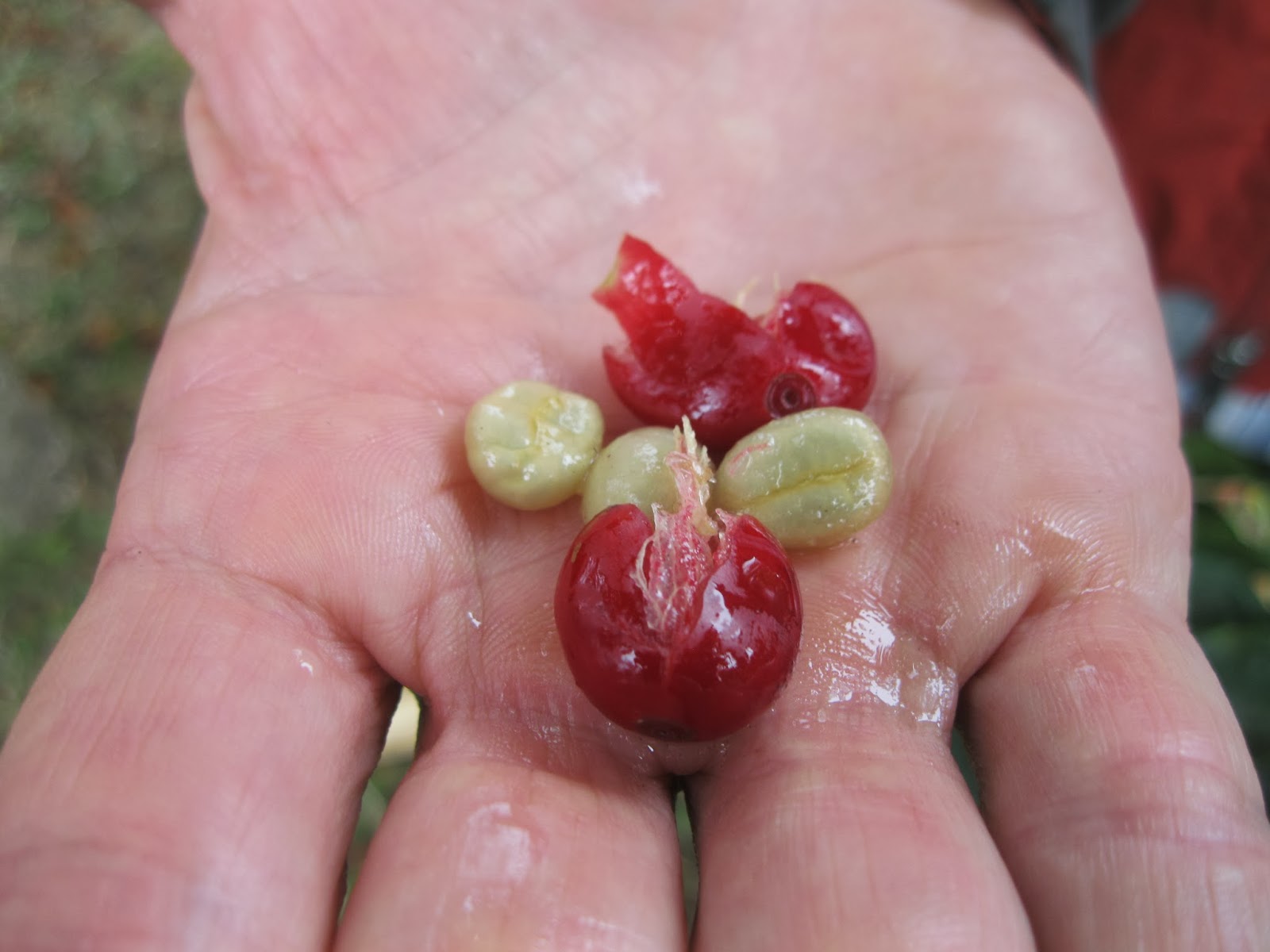
The coffee berries actually have a thin, sweet skin and pulp that must either be dried and pounded off (as Finca dos Jefes does) or soaked and worked off under water.  We learned that the former method is more expensive and takes longer, but the latter, which is usually employed, results in highly alkaline water being dumped in the nearby rivers and harming the plants and animals that rely on this water.
And there they are: coffee berries in all their glory.
 
The pulpy outside of the bean is surprisingly sweet.
 
 
Gary, the finca manager conducted our tour.  Here he's showing Jon the coffee on the drying tables.
 
Jon checking out the big mortar and pestle used to take the skins off instead of soaking the beans.

The dried, skinned beans are bagged and stored until it's time for roasting, which Finca dos Jefes does in small batches at high (400+ degrees F) temperatures. The roasted coffee can then be ground up and drunk -- either by "regular" consumers like us, or by "cuppers" who evaluate the taste, much like wine, detecting all kinds of flavors and undertones ranging from the pleasant (caramel) to the strange (tobacco anyone?) to the just plain yucky (mildew).  We tried our hands at cupping and learned that we should definitely not give up our day jobs when we guessed wrong even on the level of roast of the beans.  Still, for two individuals who are not big coffee drinkers it was great fun to learn new things about this commodity.  It's always good to learn about the things we consume, both to appreciate them better, and to become more discerning consumers who choose our products based on how ethically and sustainably they were produced.  Given that coffee is grown in dozens of countries around the world (though -- fun factoid -- Brazil is heads and shoulders the biggest producer), there are lots of opportunities when travelling internationally to visit a finca.  I'd recommend it for sure.