Monday, March 19, 2012

Jordan Challenge 28: Jordan in a Week

So, as I wrote in the previous post, after much cajoling and many empty promises I was able to convince my colleague,friend and honorary cousin Paul that what he really wanted to do was spend his spring break in Jordan.  And once he was convinced, the challenge was on me.  Chris came to visit in November, but he came for almost a month -- here the challenge was to get as much in as possible without it feeling like a relay race.  I guess Paul has the ultimate say on how it went, but my admittedly-biased take was that we did pretty well.  Here Are my Top 5 Highlights of Hosting Paul in Jordan:

1.  Two Days at Petra
So fun, it got it's own post here.

2..  Visiting the Dead Sea
Back when Paul was an undergraduate, he sailed around the world with Semester at Sea and while the group was visiting Israel, got  a chance to take a dip in the Dead Sea.  He wanted to try it from the Jordanian side, and so we did.  We went to the Dead Sea Spa Hotel, which turned out to be a surprisingly good deal. They charge 20 JD on a weekday to use their pool, facilities and beach front, but then give you 20 JD in vouchers to spend, so lunch and sodas all day turn out to be essentially free, as is the mud that everyone applies liberally to their bodies because, well, everyone else is applying it so it must be good for you, right? We also went up to the Dead Sea Panorama for a great view of the whole area and a chance to learn a little more about the history and ecology of the place.

The Dead Sea Panorama is a museum that also boasts an area with sweeping views of the Dead Sea below.  Quite spectacular.

Paul, still covered with the much sought-after Dead Sea mud, demonstrates that everything and everyone floats when they're in the Dead Sea.

3.  Afternoon in Madaba
It's not the site of Roman ruins or Old Testament stories like so many places in Jordan, but I really like Madaba.  What the city has is an array of amazing mosaics from the Christian Byzantine era, most of which were unearthed when a group of new Christian families moved from Karak to Madaba in the early 1900s and started digging foundations for their homes and public buildings. The most important of these is the "Madaba Map" of the region sitting in the floor of Church of Saint George, but there are many others at the archaeological park and even in the private homes of some of the city's prominent families.  The town has a great and easily walkable historic district and made an excellent afternoon day trip.

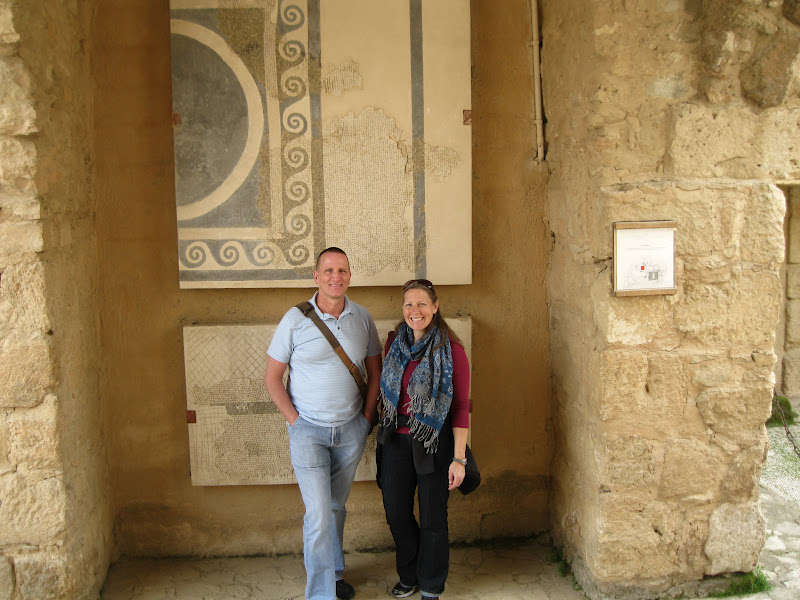
Paul and I standing in front of the oldest mosaic discovered so far.

4.  Exploring Amman
The first night Paul was here we headed to First Circle in the area of town called Jebel Amman and took a tour down Rainbow Street before grabbing dinner at Books @Cafe.  The next day we went up to the Citadel, and as I posted separately, on the last day, we were able to take a tour of the beautiful King Abdullah Mosque.

But I think one of the best things about having people come visit is that they also make you notice things the everyday things you take for granted in your own neighborhood.  Paul's curiosity led us to make visits to the two closest mosques to my home, both only a couple blocks away in opposite directions.  He also had a blast exploring the balad, the slightly chaotic and grimy, but very lively downtown area where we went on his last day to pick up a few more gifts and souvenirs.

This is one of two mosques within a couple blocks of my place.  All its domes are gilded and its truly a splendid sight.

A street scene from the balad -- decidedly more traditional and working class than the upscale neighborhoods of West Amman where we expats tend to cluster.

Gotta love the cafe -rich environment of Rainbow Street.  By his third day in Amman, Paul was on his way to becoming a Rainbow Street regular, as he hung out there while I was at work.

5.  Food and Friends
As I've noted before, one of the greatest things about this Fulbright year is that I'm sharing it with a remarkable group of talented, engaged and all-around terrific fellow Fulbrighters and their friends. Although we were out of town for much of Paul's visit, and many of them were out of town at a conference in Morocco, I am really happy that Paul got to meet at least a few of them. And of course, what better way to meet new friends, than over a meal of new foods.  While he never got to try the avocado drink that Grace recommended, he did sample (among other foods): mensaf (the quintessential Jordanian dish); musakhan (a fabulous Palestinian concoction something like a flat bread pizza with caramelized onions and chicken); fattoush (a salad with bits of dried bread, tomatoes, cucumber and red sumac powder); shawarma (a popular street food, kind of like a gyro) and kanafeh,a Jordanian dessert.

One of the worst sins of omission I can think of is to come to Amman and fail to get shawarma from the Reem stand at Second Circle.  It is so good that everyone goes there even, rumor has it, the Royal Family. Obviously, we got our Reem fix while Paul was in town.

My Fulbright friends Grace, Cooper, Mike and Christina helped me introduce Paul to mensaf at the Al Quds restaurant in the balad.  The reflection in the mirror is Marzieh, yet another Fulbright friend who obligingly took the picture.

A serving of mensaf, up close and personal.

Afterwards we went to a sweet shop next door.  Here are Cooper and Paul sampling the kenafeh.
Although we didn't get to Jerash, Ajloun or Um Qais to the north, or Aqaba or Wadi Rum to the south for a week, I'd say we did pretty well.  Jordan's not a big country, but its warm hospitality, spectacular landscapes and historic and religious significance make a big impact. And there's nothing like showing off something you've grown used to someone who's new to it to make you realize what you've been taking for granted.  Thanks for the reminder, Paul, that I'm mighty lucky to have landed here in Jordan for the year!

Saturday, March 17, 2012

Jordan Challenge 27: Visit a Mosque

One of the most interesting things about living in Jordan is experiencing the degree to which Islam is interwoven into the daily lives of the people of the country.  I hear the call to prayer from two different mosques five times every day, and Arabic language is full of references to Allah, from the phrase  "insha'allah" (if God wills it) which is the standard reply to any proposal or plan, to "al-hamdollilah" (praise God) which is a common reply in greetings. I've been told that most Arab countries have a major mosque that is routinely open to non-Muslims, and in Amman, that mosque is the beautiful blue-domed King Abdullah mosque.  When I told Paul that visiting  it had been on my list of Jordan challenges since I arrived here,  he readily agreed that we should go.  And so, on his last day here we ventured out into the pouring rain for a final field trip.

It took Paul and I a minute to figure this one out.  It's a digital display of the times of the daily call to prayer (it's pegged to sunrise and sunset, so it changes)

I knew that I would need to cover my head, and was planning to use the scarf I was wearing but when we arrived we found that they had a room full of abaya gowns with hoods for non-Muslim women to wear, so I put one on, we took off our shoes and in we went.  The key feature of the King Abdullah mosque is its huge blue dome, which on the inside is also blue, with gold lines running down to the base of the dome, and said to represent rays lighting the 99 names of Allah.

Wearing the hooded abaya lent to me by the mosque for while I was inside


Paul didn't have to cover his head and clothes, but we both needed to take our shoes off.
Like all mosques, it does not have pictures or statues of the Prophet Mohammad or any people or animals because, at least as I understand it, that could become a form of idol worship.  Instead, the interior is decorated with beautiful geometric patterns.  This is one of the things that makes it feel very different than Christian houses of worship; the other is the lack of objects, or even chairs, since worshippers will kneel on the floor facing Mecca.

For most of the time, we were alone in the mosque and had a great opportunity to look at the beautiful ceiling and patterns throughout the interior.

The mosque was built in the late 1980s by King Hussein, father of the current King Abdullah II, in honor of his grandfather, Abdullah I.  It served as the National Mosque until 2006 when it was replaced by the King Hussein Bin Talal Mosque.  But it is still huge, with the main chamber able to hold 3000 worshippers, and though that was a bit difficult to imagine on our visit, when it was just Paul and I and a European tour bus, it must be quite a sight when it's filled to capacity
A view of the King Abdullah Mosque from outside.

One final noteworthy detail about the mosque is immediately evident from the courtyard outside -- the close proximity to the Coptic Church right across the street. Although Jordan is overwhelmingly Sunni Muslim, I have found the Islamic Jordanians very respectful of Christians (who make up 5-10% of the population) and their holidays and traditions.  Although the weekend here is Friday and Saturday, many employers swap Sunday for one of the weekend days so Christian employees can attend church. Christmas, though generally not celebrated by Muslims is given off as a holiday, and my students and Jordanian friends thoughtfully went out of their way to offer me Christmas greetings and gifts to be sure I would enjoy the holiday they did not share.  I've found it interesting as an American educator to note that schools here make more concessions for their Christian populations than we do for our Muslim, Jewish and other religious minority students. In a world where we tend to have our eyes and ears trained to constant talk of "extremists", the siting of the King Abdullah Mosque next to the Coptic Christian Church is just a small reminder that peaceful co-existence is a mainly a matter of mutual respect.
The view of the Coptic Church steeple from inside the courtyard of the King Abdullah Mosque.

Friday, March 16, 2012

Jordan Challenge 12.2: Petra for Morning People

For the last week, I’ve been hosting my friend/colleague/honorary cousin Paul who’s been visiting me from Vermont. We’ve had all kinds of fun adventures that I’ll write about in another post, but since one of the original challenges on my list was to visit Petra three times, and in three different ways, I decided to write about Petra separately. I went earlier this year with Chris, and the new element for me was taking the Petra at Night tour, which is an amazing visual experience. The one thing that was a bit disappointing about it was that it drew a major crowd, and so though it was wonderful, it was definitely, well, crowded. This time, I learned a valuable truth. If you want Petra to yourself, go in the morning.

Just outside the entrance to Petra, some of the shops are still capitalizing on the memorable scene that Harrison Ford filmed as Indiana Jones riding through the Siq and coming upon the Treasury.


In order to make the most of this trip, Paul and I took full advantage of the fact that we are morning people. We decided to go for two days, which means getting up really early to catch the 6:30 am bus on the first day. It’s a three to four hour bus ride from Amman, so when we arrived at Wadi Musa, the town that Petra was in, we first stopped by La Maison Hotel, where we’d be spending the night, and they obligingly let us check in early. From there, we did an early lunch and then headed into Petra for a day of exploring.

As I’ve mentioned in previously posts, one of the most amazing things about Petra is the Siq, which is a 2 kilometer long gorge that you walk through to get into the ancient city. It’s not like anything else I’ve ever walked through, and it’s all the more spectacular because it dumps you into a big open circle with a giant carved tomb (the Treasury) directly in front of you. Walking out from the Siq and facing the Treasury is surely one of the most visually stunning things a person can do, and probably one of the most-photographed moments in the world. This was my fourth trip to Petra, but it never loses that charm. We also, of course, hiked along the roads lined with tombs and later Roman ruins, and did the obligatory trudge up to the Monastery.

We had also resolved to try another highly-recommended Petra activity – visiting a Hammam. I had already visited one with my good friend and Fulbright explorer Elizabeth in Amman, but there’s something very enticing about ending a sweaty, tiring day of hiking in the desert with a Turkish bath. We took the hotel’s recommendation to go to the Nabatean Bath and were not disappointed.

Outside the Nabatean Hammam, which I cannot recommend enough as a night-time activity after a day of marching around the caves and cliffs of Petra.

Next day was the time to try out our theory that Petra in the early morning was the thing to do, and we were wildly happy that we had. If you want the Siq and Treasury to yourself, we learned, the time to be there is around 7 am. No one is around but a few Bedouin merchants starting their day and the camels and donkeys. The Siq and Treasury are always great, but to have them all to yourself is really an unforgettable experience.


Paul, enjoying the unusual experience of solitude walking through the Siq..

..and being able to sit all by himself on the steps of the Treasury.
We also hiked up to the High Place of Sacrifice, with virtually no fellow travelers.  There, we took advantage of having the place to ourselves to try to explore the actual slab where the Nabateans sacrificed the animals and also to let me do some of the burpees I needed to do to keep up with my 100 burpee challenge (it was day 78, I think). I only did a set or two there, but it's definitely the most memorable place I've done them (with the outside lobby of the Dead Sea Movenpick Hotel during the archeological dig with Elizabeth coming in second).
Sarah, our Fulbright exercise guru, will br proud to know that I didn't let my visit to Petra keep me from doing my daily burpees.  We had the place to ourselves and it was wonderfully flat and spacious.

They didn't actually ever sacrifice humans here in ancient times, but I asked Paul to do a bit of dramatic interpretation.

...and here he is in his second role -- Paul Olsen, yogi master.

Should anyone be planning a trip to Petra, here are the lessons I learned from Part II of my See Petra Three Ways Challenge:

• Get a two-day pass. It takes all the pressure off of having to see everything the first day.

• Hike hard the first day and hit a hammam in the evening for a fabulous experience.

• If you like to have a place to yourself, get up early and hit the trails. Unless you’re Bill Gates and can buy out the Park, this is the closest you will ever come to having your own private tour through the Siq and at the Treasury. Totally worth it.

Tuesday, February 21, 2012

Jordan Challenge 26: Go on a Dig

Of all the things on my list for the second half of my Jordan experience, I think this is the one I most hoped would come to pass, and I am happy to report that it has.  I just came back from an amazing day spent mainly digging in the mud -- but this was no ordinary mud. This mud lies within Tall el-Hammam Excavation Project (TeHEP), the archaeological site near the Dead Sea where I spent the day.

I learned so much it's impossible to encapsulate in a blog-style post, so I thought I'd do what I do best -- which is to make a list -- in this case, a list of Five Things I Learned from my Day at TeHEP.  Here they are:

1.  Excavation sites can be enormous.  The excavation team that has been working on Tall el-Hammam for the past six seasons (the seventh is now nearing its end) believes that the site is actually the ancient city of Sodom, which was written about in the Bible (and, I've since learned, the Torah and Quran as well).  The site being work on is a square kilometer, and in the walk around tour that Area Supervisor and Senior Archaeologist Steve McAllister conducted for us, we went up and down talls (hills) and areas with springs and areas where walls and gates had been at a fairly dizzying pace.
Here's Elizabeth standing in the square she's been working on for much of this dig season.  It turned out to be an outdoor kitchen courtyard, complete with remnants from the circle where the fire was and pots and cooking implements.

One of the most interesting things I learned about was the theory that this site also contains the remnants of a Roman-era city, Livius -- or at least that's the theory of David, who just published a paper on the subject and has been a part of this project for seven years.  He's the one standing furthest to the right. He and Irina (in the red jacket) came all the way from Moscow for the dig.

2.  Archeology requires patience, and also a willingness to get very dirty. The site we are working is divided into something like 60 THOUSAND squares.  In seven seasons of digging less than one half of one percent of those squares have been opened up and explored.  And the process of "opening up" a square is actually a euphemism for "digging very slowly, and in shallow layers, usually with hand tools, while looking for bits of past civilizations via foundations of buildings and structures and pieces of pottery shards and domestic items."  The process of moving dirt by hand is by definition dirty, and at the end of the day, once all the equipment has been cleaned and packed up, and the volunteers and staff dispersed, there is a regathering of people to do yet another dirty process -- scrubbing pottery shards.  The shards of the day are put in tagged buckets showing where they came from, and the previous day's soaked shards are scrubbed clean and sorted for the staff to "read", which means figure out where the bits came from, and more importantly, when they were created and used.  Unusual or more intact pieces (a very small percentage of all that were gathered) are individually tagged, bagged and saved.  The rest are brought back to a "pottery dump" near where the equipment is stored.
Some of the many, many shards of pottery in the dump.  I had not thought about the fact that you can't just put them any old place on the site -- that could be extremely misleading for future excavators.  So, you designate a dump site and they all go there.

Elizabeth and I split a bucket of shards to scrub before we could call it a day.

Another nice aspect of the dig is the camaraderie.  At the end of the day, everyone wants a little down time, but everyone pitches in and does the pottery washing before anyone calls it quits.

3.  Archeology is part science, part art, with a big dose of imagination thrown in the mix.
How do you know what level of precision (and hence what tools to use) when digging?  What is fact?  What is theory?  How do you take a row of stones and surmise existence of a whole wall or rampart or fortress?  The Tall el-Hamman project is a perfect example of many of these dilemmas.  Since it's so huge, the team that has been working on it for the past seven years must balance the urgency of getting some results in a season that lasts 6-8 weeks with the need to be as careful as possible with excavations so as not to miss important things or accidentally destroy important evidence (like mud brick walls, which to untrained eyes like mine look amazingly like plain old packed dirt).  Then there's the whole big picture issue.  For some, Tall el-Hamman is the city of Sodom, vividly described in the Book of Genesis as the place where Abraham's nephew Lot relocated, but which was so wicked that it contained not even 10 good men, so was ultimately destroyed by God. Lot suffered still another misfortune when he fled with his family, and his wife disregarded God's warning, turned and looked one last time, and was turned into a pillar of salt.  Others argue that, Biblical interpretation or no, there was clearly one very big city there, and there is a gap in its habitation during the Late Bronze period (1550 - 1200 BC) that needs explaining. 
It wasn't the perfect workday weather wise -- cold and rainy and windy.  But of course, that didn't stop me from peppering Steve  with a million questions while I tried to move a little dirt around.

4.  The archaeological subculture is fascinating.  A day delving into a whole new world or subculture is not really enough time to learn very much.  But it is sufficient for giving a sense of what you don't know.  I now know that archeology has its own methodologies, debates, tools (my favorite new word: "gufa" is a basket for dirt made out of old tires) and types of people that are drawn to it.  Some of these people, like Dr. Stephen Collins, who is the director of the whole enterprise, and the senior staff, have devoted their lives to archeology and either have their PhDs or are in the pursuit of them.  But others have whole different careers and lives for the rest of the year, but carefully organize their years around "dig season" to come back and participate again and again.
Scrabble players and crossword puzzlers take note: behold the gufa. It's a basket made out of old tires for lugging dirt around.

5.  Archeology can be fun!  Easy for me to say, since most things are really fun the first day you try them.  But actually, the whole thing was just awesome.  I got really muddy, learned a lot about what Elizabeth's been working on all this time, and selfishly, feel like I got to see a whole new world -- archeology-- in action after years of Indiana Jones images dancing in my head.  I might have to do some investigation and see about actually volunteering in a dig for all or part of a season sometime.  But whether I do or I don't, this definitely will have been one of the most memorable days in one of the most memorable years of my life, and I owe a huge debt of gratitude to the people of the TeHEP, and especially to Elizabeth, for letting me crash for a day.
My favorite moment in a wonderful day.  Senior Archaeologist Steve McAllister had thoughtfully set up a car stereo so we could have some music to dig by.  When "Sweet Caroline" came on, he and Director Steven Cullins suddenly broke out in a synchronized dance.  Nothing like seeing two eminent archaeologists dance in the rain, whilst Elizabeth and I were digging in the mud below.

The day got called early because of the rain.  Here are Elizabeth and I, pretty muddy, but otherwise feeling like a great day had been had by all -- especially me.

Monday, February 13, 2012

Jordan Challenge 25: Visit a Biblical Site (or Two)

In one sense, it’s hard not to be a Biblical tourist in Jordan because parts of the country have been travelled by lots of the Old Testament prophets and by Jesus and his disciples in the New Testament. But I did want to make more of a concerted effort to deliberately go to two fairly prominent destinations of Christian Pilgrims who come to the area, and given that they are less than an hour’s drive from each other, it made sense to combine the trips. Happily, my friend and fellow Fulbrighter Elizabeth K. (not to be confused with Elizabeth R. who is off doing the Indiana Jones thing at an archeological dig at the Dead Sea), also had this trip high on her own to-do list. In no time at all we recruited two other friends, Christina and Ben and -- taxi nicely filled to capacity – we were on our way.

Our first destination was Mount Nebo – not much as mountains go, measuring in at a whopping 800 meters high, but very significant from a Biblical standpoint – according to the book of Deuteronomy, this is the place where God spoke to Moses and showed him the Promised Land that he would never be able to enter. It is also said that Moses climbed back up the mountain to die (a pretty major feat considering that he was 120 years old at the time of his climb), though no one knows the exact spot where he met his end.
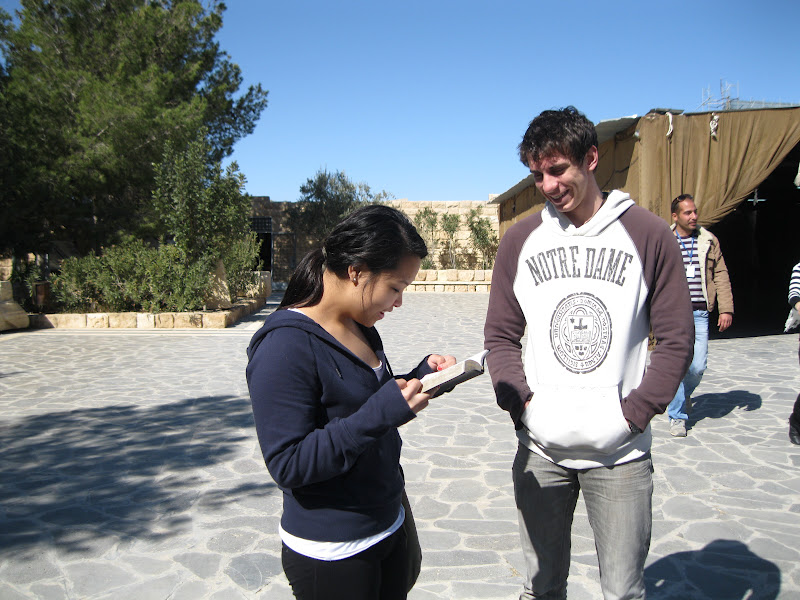
Elixabeth K. was clearly once a Girl Scout who took her Be Prepared training seriously.  As soon as we got to Mount Nebo, she whipped out her Bible and read the pertinent passages to those of us, like Ben, who were Not-So Prepared.
In case you were wondering what the Promised Land looks like from the top of Mount Nebo: this is it.
After reading up on the various saints and religious orders that have visited and maintained Mount Nebo over the centuries and taking a look at some impressive mosaics on the floor of the to-be-reconstructed Church on the site, it was time for Phase Two of our religious tour, and we hopped back in Yousef’s cab to make our way to the Bethany Beyond the Jordan tourist center. There we each parted with 12 JD (about $18), which entitled us to a tour guide, an electronic device that narrated our tour when we pointed at spots on a card with our special pointers, and a short ride on a tour bus closer in to the River.
Despite being sorely tempted, I did not buy a t-shirt to commemorate my visit.  But I could have, and that's the reassuring part.
I have to say that if Jesus was to return and feel like chiding us humans on our poor environmental stewardship, the Jordan River would be a good place to start. The songs I learned in Sunday school as a kid said that “the River Jordan is deep and wide” but now it’s neither. Our guide told us that the river used to be 140 meters across – now it’s ten. And it’s incredibly polluted.
Christina, Ben and Elizabeth, standing in front of the muddy-but-no-longer-mighty River Jordan.

One of my all-time favorite non-governmental organizations, Friends of the Earth Middle East,(about which I raved in a blog post last summer) have taken on the monumental challenge of rehabilitating the River and I feel like the rest of us owe them a whole lot of support and gratitude. Despite the environmental issues, it’s hard not to use your imagination and try to think about what it must have been like when John the Baptist was living here and baptizing people in the much cleaner and more plentiful water.
Before the waters receeded so enormously, this used to be the place where religious pilgrims would be baptized...

...as shown in the right side of the fork in the river in this mosaic at the site.

I think one of the most interesting experiences of being a grown-up is seeing things you learned about (and envisioned in your head) when you were a little kid. So far, from what I’ve seen of the Middle East, the mountains are lower and the rivers more shallow than the ones in my mind’s eye. But it’s still an amazing thing to be able to put an actual physical place together with the names and stories I’ve been carrying around in my head since preschool. Just one more reason to be grateful for this opportunity to spend a year in Jordan.
Couldn't resist -- pullution or no, just had to dip my fingers in the first river I ever learned about as a child.


Saturday, February 4, 2012

So Much to Do, So Little Time: Jordan Challenge Part II List Update

Now that I've recapped what's happened from the list in my previous post, this one is dedicated to the things from the original list that are still yet to be tackled, as well as some add-ons that others have suggested or I've realized are just begging to be done.  I really hope my Jordan-based friends will take a look and let me know which things they want to do together and what else should be on the list. Here's to a great second five months!

Still on the List:

Get to Know my Neighborhood (and Take a Bus). Anyone who knows me knows that directions are not my forte. I’ll probably leave Amman still not really knowing my neighborhood, but I have made a concerted effort to visit different parts of it, and I’ve decided that the best way to figure out where it is in relation to other places is to take the city bus that runs through it sometime. I always feel very intimidated taking buses in foreign countries because of the language and directional barriers, so facing that fear is probably another good reason to do it.

Learn Some Arabic. I had an ambitious 3-part plan for learning Arabic on my original list and then had the rug pulled out from under me in my discovery that Arabic is hard. As in really hard. I did have a tutor for a few months and attended a great conversation class in the fall, so that was a good start. My challenge now is to try to spend a few minutes each day with my notes and lessons to try to at least remember what I learned.
Proof that I really did try: Here I am with fellow classmates Matis and Tess and our endlessly patient and good-humored Arabic teacher, Ali.


Cook a Jordanian Dish. There are a number of ways this one might happen, from taking a formal class with my friend Elizabeth to talking my friend Doa’a’s sister, Alaa, into doing a teaching swap whereby I teach her to make Peanut Butter Blossoms and she teaches me to make one of the many Jordanian foods I now cannot live without. Or maybe both – we’ll see.

Cook a Jordanian Dessert. Again, anyone who knows me knows that I put regular cooking and the cooking of sweets in separate and equally important, categories. This one was suggested by Fulbright Carpetlander Luke, and he and I and the other Carpetlanders are going to take an afternoon to learn to make ma’amoul, a Jordanian cookie that comes filled with pistachios or dates.

Ride an Arabian Horse. Not sure about the specifics of this one yet, but Katrinka suggested it, and I’m doing it, once I find a place and a co-conspirator or two.

Run in a Jordan Fun Run. The problem on this one is not finding a run – there are plenty but they are way too intense for me right now. Unlike the Fulbright and Friends Team preparing to relay the Dead to Red, or Angela and Kelsey getting ready for the Dead Sea Marathon, I just want a simple little 5K that I can do and get the t-shirt from. Once I find it, I need to twist some arms of friends to do it with me, but I’m pretty sure it will happen.

Watch a Movie in Arabic. Haven’t gone to the movies (except for local film festivals) since I came to Amman. But I want to have the experience of going to a regular cinema and watching a feature-length film in Arabic, just to see what it’s like.

Visit Petra Three Ways. One down (Petra by night with Chris) and two to go.

Go on a Dig. My good friend Elizabeth is currently on a dig as I type, and it is my strong hope that I will be able to crash it for a day or two and see what it’s like.

Rock Climbing in Wadi Rum. I’ve been to Wadi Rum (twice) and I’ve started rock climbing again (finally). So, I’m hoping that the two will come together in the next five months and I’ll get a chance to try climbing outdoors on those beautiful desert cliffs.
Next time, the idea is that it will be me, and not the camels, doing the heavy lifting in Wadi Rum

Snorkeling in the Red Sea. This one may just be getting an upgrade. Elizabeth and I are hoping to try scuba diving while we are here, and if we do, it’ll be in the Red Sea. So, snorkeling is the fallback, but here’s hoping we go all the way to oxygen tanks before I leave.

• Visit the Desert Castles. A simple day trip away. My friend Paul is coming in March, and I think this may go on our itinerary.

• Hike a Jordan Nature Reserve. There are a whole bunch to choose from, and when the weather gets nice again, I’ll either do this through Wild Jordan or find a group who are interested in winging it.

• Visit a Biblical Site. My rock climbing buddy Elizabeth K. has this one on her list as well. I think we’ll be headed to Jesus’s baptism site (Bethany beyond Jordan) and maybe Mount Nebo as well, soon.

The Caves of Zahle. Missed these on the first trip to Lebanon, but it might be one of many reasons to go back.

• Return to Bethlehem. Hoping to take a trip to the West Bank with Cooper and some other folks in the next few months and stop to see the wonderful friends Kate, Alexsis and I made then.

• Go to Turkey. If one more person tells me how awesome Istanbul is, I might scream. I think this may be the next plane ticket I buy, particularly if Elizabeth still wants to go soon, too.

Take a Ferry to Egypt. Rather than fly, I think it would be neat to go across the Red Sea to the Sinai Peninsula to visit Egypt, especially if some other people would like to do this one together.

Now That I Know: The Add-Ons:

Paint a Plate. Although I must confess I’ll be very happy to trade my gym membership at Power Hut in for my old one at the Y in Burlington, it has had some advantages, including the fact that it’s the place I met my good friend Doa’a. And Doa’a introduced me to her equally great sisters, Raghad and Alaa. We have a plan to go paint ceramic plates together, since I am severely limited in the artistic realm (as opposed to Raghad, who lives to draw), it should be a great little challenge.
Doa'a, Raghad and Alaa, ready for adventures in plate painting and hopefully, some of the other challenges on this list.

• Do a Combo Bike/Hike. The two biking outings I’ve done with Cycle Jordan have both been great, and now I think I’m ready to go to the next level and do one of their combination bike and hike excursions. This one will have to wait till the winter’s over and the wadis are re-opened for people ready to wade through them. Should be a good adventure!

The 100 Burpee Challenge. I’ve come to learn that my fellow Fulbrighters are a group with many talents. Sarah I., for instance, is not only possibly the most physically fit person I know, she’s devoted to helping the rest of us in that regard as well. She issued a call to three of us (Mike, Almas and me) to join her in a 100-day challenge, and we foolishly accepted.

The idea is that we do Burpees --an exercise that involves a lot of jumping around with pushups in-between. The first week, starting with one Burpee on day one and ending with seven on day seven, it seems like cake. But after about day 20 a bit of anxiety sets in. You have to try to do them continuously and time them on days 25, 50, 75 and 100 (the day of this writing was day 39). Sarah, having already done the Burpee Challenge is doing an even tougher one with jump rope double-unders. But we’re more than a third of the way; can’t stop now.
You'd never guess that such an unassuming character as Sarah (in blue, shown here with Elizabeth, Gaelle and Jayme as we're about to do some Dead Sea biking) could have masterminded such a cruel plot as the 100 Burpee Challenge.

Pay our Regards at the Duke’s Diwan. This one is all Elizabeth. She heard about the Duke, who lives in the oldest house in Amman and allows people to come to tea and hear him discuss the local history and attractions. Sounds like a blast.

Volunteer at Jerash Camp. Through my friend and fellow Fulbrighter Jackie I learned of Julia, a one-woman force of nature who volunteers at the Palestinian Refugee Camp in Jerash (locally known as the “Gaza Camp”). Kelsey, Jayme and Jackie have all volunteered there, and I’d like to join them.

Find Out How Many Fulbrights Can Fit on a Wall. It took way too long, but in the month of January I finally went to Climbat, Amman’s rock climbing gym (and the first in the Middle East) three times. Jayme is a veteran climber, and made it possible for me to go the first time. Since then I’ve gone climbing with 5 additional Fulbrighters: Elizabeth K., Usama, Kat, Christina and Kelsey (plus new friends Gaelle, Ahmad, Tim and Ben). Elizabeth K. and I have big plans to start going regularly on Fridays, so a logical new goal is to see how many total Fulbrighters we can entice onto the wall before the year is out. I’m going for at least twenty on this one!

Take a Wild Card Trip: Eastern Europe or Oman? One of my favorite procrastination past-times is to check out cheap flights from wherever I am to see what unexpectedly travel opportunities might be out there. Turns out there is a direct cheap flight from Amman to Budapest (and I’ve never been anywhere in Eastern Europe and wanted to go for ages), and Oman is also very affordable. I think one or the other (or in a perfect world, both) needs to be visited before I head back to the U.S. for good.

Something Else Spectacular. I’ve now been writing and following lists since January, 2010 and it’s taught me a few things about lists. Like, lists are good – they keep me active and engaged and looking forward to doing new things and inviting people to do them with me. They’ve also taught me that, though it’s good to make plans and lists for the future, it’s impossible to know what will come your way. Some of the best things I’ll do in Jordan from now till the end of June have yet to reveal themselves. But when they do, I’ll be on it. In the meantime, here’s hoping that all my Jordan based friends (and friends who will be visiting) will check out the list and let me know what they are interested in doing together!

The Jordan Challenge LIst: What's Done So Far

I’m in-transit back to Jordan on a marathon flight itinerary: one hour flight from Burlington to Newark; five hour layover at Newark; eight hour flight from Newark to Frankfurt, Germany; seven hour layover in Germany and five hour flight to Jordan. I’ve been trying to use the time productively reading books I’m using for classes this semester, but I thought it would also make a good time for reflection on my Jordan Challenge List because I am now officially at the halfway point of my 10 month Fulbright Fellowship in Jordan. So, I’ve decided to take a look at the original list, see what I’ve done and what I have left to, and also consider what other things I want to add to the list as the result of the first half of my Fulbright experience. There’s a lot in both categories (that is what I’ve done, and what I still hope to) so I’m going to split the write-up into two posts.


This is the first post: Starting with what’s been done, here are the things I said I’d do and did, followed by other things I did that weren’t on the original list.

Cross It off the List:

Learn to Use my Washing Machine (Challenge #1). First thing I did, and a good thing, too. I’ve gotten used to hanging my clothes to dry as well, and hope to continue doing that when I’m back in the US to reduce my carbon footprint a little.

Learn to Use my Oven (Challenge #3). Did this one quite early too, though some might argue that it wasn’t a complete success, since my oven later attempted suicide in a rather spectacular fashion as it was about to be impressed into service cooking Wigilia Dinner for 26 people.

When the oven wasn't busy self-destructing, we've actually had a pretty good relationship, as exemplified by these Christmas cookies it turned out rather well.

Go cycling with Cycle Jordan (Challenge 4 and 24). Had a great time on both trips and surely hope to go again, multiple times, before I leave Jordan.

Visit the Ruins of Jerash (Challenge 8). This was the first of many trips I’ve taken with my excellent fellow Fulbrighter and friend Elizabeth. Jerash is the largest and most well-preserved of the ten cities set up by the Romans when they ruled the area, and very worth a visit, especially if you bring your imagination.

Our Jerash and Parts North Day Trip was the first of many adventures Elizabeth and I have taken since arriving in Jordan.

It was a perfect day for exploring the extensive ruins on the grounds of Jerash, and we took full advantage of it.

See the Ruins of Um Qais (Challenge 8). On the same day, we also visited Um Qais and the Crusade-era castle of Ajloun. If you go, be sure to pay homage to the pigs who committed mass suicide by running like lemmings into the Sea of Galilee when they were inhabited by the demons that Jesus cast out of some tormented humans.

Visit the Dead Sea (Challenge 16). Although the Dead Sea is a unique place, what made this visit truly memorable was doing it with Chris. The weather was awful – chilly and rainy – and we were part of a very small group of intrepid travelers who were going in no matter what. But Chris was having so much fun that his enthusiasm was totally contagious, and made what could have a been a frustrating day lots of fun instead.

Chris is the only person I've ever known to stay in the water longer than the obligatory floating pose period.  He loved it, and thought it was great fun to feel so buoyant.

Explore the Tiles of Madaba (Challenge 18). Lots of people overlook Madaba because it’s overshadowed by some of the Big Names, like Petra and Wadi Rum. But that’s too bad. The mosaics are great, the churches and ruins where they’re housed are fascinating, and the old town is charming. I’m glad Chris was up for a visit, and had a great time when I returned with Elizabeth, Grace and Hannah as well.

Experience a Hamman. (Challenge 20). What I learned from visiting the Pasha Hamman is this: Hammans are awesome. Many thanks to Elizabeth for suggesting this birthday weekend activity. It’s also the closest I’ve ever felt to having a whole new skin. I shall return.

Visit Lebanon (Challenge 21). As I noted in my post on this one, on the basis of this one weekend Beirut vaulted to a place in my Top Five Cities I’ve ever visited. Cannot wait to go back.

Visit Tel Aviv (Challenge 23). This was part of a larger visit to Israel and the West Bank that Chris and I took. We saw a lot, learned more, and generally had a great time.

Bonuses Along the Way:

Learn Something about Antiquities (Challenge 2). This is definitely one of those advantages that come of being at a particular place. I came to Jordan knowing next to nothing about archeology and the ruins of the Near East. But it’s a great place to attend free talks, ask lots of questions, and see things for yourself. I’ll leave with at least a little more knowledge and a lot more interest, that’s for sure.

Become a Rainbow Street Regular (Challenge 6). Friday brunches at Books Cafe, discovering the other restaurants and cafes of the area, meeting friends and doing work at Turtle Green – what’s not to love? Every city should have an area like Rainbow Street and First Circle.

Exploring Rainbow Street means (in part) trying all the different cafes in the area. Here are my friend Doa'a and I upstairs at Bifrost.

Teach at University of Jordan (Challenge 7). Since writing this post, the first semester is done, and though I managed to make more than my share of mistakes (I now know, for example, the importance of using paper that has been officially stamped for final exams), my students were terrific and we parted on excellent terms. I’m hopeful that the second semester will have in store even more great conversations and mutual learning experiences.

Wadi Rum (Challenges 9 and 13). I never thought I’d enthuse about a desert so much. But I’ve been there twice, once with Elizabeth and again with Chris. The experiences, like the desert itself, were widely varied, and I loved them both. I’m hoping to go back at least one more time to have the experience of rock climbing outside as well.

Rain (Challenge 10). Before this trip, my vision of Amman was as a dry desert city. But anyone who visited in November, particularly this November, would come away with quite the different impression. But Chris helped make the most of rainy time, happily forging ahead to dodge the drops to swim in the Dead Sea, and refusing to let a downpour stall our night-time arrival in Madaba.

As Mike would quickly tell you, Mensaf (the Jordanian national dish) should be eaten in any weather.  So he didn't hesitate to take Chris to Al Quds for Mensaf despite the fact that it was pouring outside.

• Eid Al-Adha (Challenge 11). This actually turned out to be a great advantage this year. Eid Al-Adha is a very important holiday in the Muslim calendar and this year it was longer than usual, thereby lengthening school vacation time and my travel-around plans with Chris (at the same time that it complicated them when (like border crossings) closed and buses were more than usually crowded with vacationing families.

Visit Aqaba (Challenge 14). Although Jordan is considered a landlocked country, it does have a few miles of coastline along the Red Sea, complete with coral reefs, and the city of Aqaba makes the most of it. Chris and I were lucky to visit, though I hope to return to try scuba diving there with Elizabeth.

Field Trip to the Royal Auto Museum (Challenge 15). This was yet another of Elizabeth’s great ideas, and Chris and I spent a rainy afternoon there one day, together with what seemed like half the school children of Amman.

Fulbrighter Thanksgiving (Challenge 17). This is a hallowed Fulbrighter tradition, and I can see why. Though the Fulbright Commission anchors it with the provision of three turkeys and a host of traditional pies, it’s also an opportunity for all the Fulbrighters to show off their cooking chops and they do. We all rolled out stuffed to the gills and appropriately thankful for many things.

Finding Christmas (Challenge 19). This wasn’t as hard to do as I had anticipated. Though Jordan is overwhelmingly Muslim, there is a small Christian population, and a number of stores and restaurants and areas that cater to westerners and Christians indulged in some Christmas decorating. Our second trip to Madaba, a town with a sizable Christian population, put us in a decidedly Christmas-y mood, and my cookie-baking frenzy sealed the deal. I was also touched by the thoughtfulness of my students – none of whom are Christian, but all of whom sent me messages, texts and even gifts to make sure I had a Merry Christmas.

Host a Fulbrighter Wigilia (Challenge 22). I think this was one of my favorite challenges of the year so far. It turned out a lot bigger than I expected (26 people came to the dinner), but so was the help and general willingness of everyone to throw themselves into the experience. I had a fabulous crew of friends who spent most of the day before Wigilia learning to make pierogi, ushkas and borscht. And I’m willing to bet we celebrated the biggest, and possibly the only, Wigilia to happen in Jordan in quite a while.

Here are Elizabeth and Donna on pierogi detail the day before Wigilia.

Having failed to get a group photo at Thanksgiving,  most of the attendees of Wigilia posed for one together that night.

So that’s the story of the first five months of the Jordan Challenge. Next up is the list of everything I hope to do in the five months remaining. Here’s hoping that it will be an open invitation to my Jordan-based (and Jordan-bound) friends; let me know what you want to do, and what I left off the list!