Sunday, March 23, 2014

5. Try Curling

Although this entry is frightfully late - we actually did this one right before the Winter Olympics began -- it still feels vaguely appropriate to post about it now because we seem to be in the Winter Without End.  It's late March and still the snow and ice and sub-zero temps just keep coming.  So, if that's the way it's gonna be, then good.  Because I have a whole bunch of winter activities to write about, beginning with this one. 
Curling!  Here's Jon, showing off the all-important (and expensive $800+) curling stones under the watchful eye of our coach for the day.
So, curling.  That much-maligned, "is-it-REALLY-a-sport?" sport.  On the basis of my one brush with the skills and strategy of this game, I do not feel qualified to answer that burning question.  But I will say that, as with almost every new thing I've tried this year or in the 2010 New Things year, it's certainly harder than it looks.

First lesson of curling: ice is slippery.  Before you can do anything else, you have to learn to keep your balance doing sliding lunges, as Matthew and Christi are doing.
  
 And all my friends who yawned and politely declined cheated themselves out of an afternoon of humbling realizations about their own limitations with running, scrubbing and sliding on ice. And also, some great poutine. But luckily there were three takers, my perennially good-sport sweetie, Jon, and friends Matthew and Christi, who agreed to journey down from Montreal to meet us at the rink just over the border in Bedford, Quebec.
The four of us signed up for a learn to curl workshop put on by the Green Mountain Curling Club, and were paired with another newbie from Jericho, Vermont to form our four person+1 rotating team. The positions all have great names: lead, second, vice and skip (who, rather than the lead, is actually calling the shots).
 But of course, before we could play we had to learn the moves and the all-important vocabulary. Like bowlers, real curlers wouldn't be caught dead without their own curling shoes and stones, but since they're pricey we newbies got to borrow stones and use curling foot pads that we stepped on with our regular shoes as we learned to throw the stone.  Which, I repeat, was not as easy as it looked -- since it ends with the person throwing the stone lunging and sliding down the ice. And the stone has to make it to the hog line to even be considered in play.
The agony of the defeated stone thrower. All that effort and it didn't make it to the hog line.  But at least I didn't fall over.  Bonus on that one.


Once the stone is thrown, it's up to the scrubbers to help it down the ice and guide its path by running in front of it while scrubbing the ice in its path. 
Christi and Jon spring into action as scrubbers.

And there's the skip calling down from the opposite end of the rink telling everyone what to do (and if a skip doesn't realize that she just got promoted from vice skip to skip and it's her turn to pay attention and yell "scrub" down the ice really loudly it's possible she will get yelled at by her frustrated curling coach).
The skipper must also strategize about where the stone should be thrown to knock the opponent's stones out of position -- another task that in which I was less than stellar.

Despite offering several hours of our lives putting our best efforts in (and taking some embarrassing slides) to learn the fine art of curling, we lost our match, but we didn't care.  Our consolation prize was the best possible one a person travelling through rural Quebec can get -- poutine, of course.  Curling is definitely not going to replace ice skating in my book, but when it comes to junk food, it's Quebec for the win.
The all-important apres-curl.  Featuring Christi, Matthew, Jon and a couple of big plates of fries, cheese curds, and gravy -- junk food of the Gods.

Wednesday, February 26, 2014

4. Eat Bugs

When we were both in our early twenties, my sister Katrinka had a college professor, Ben Parker, who she used to run around quoting.  Her favorite Ben Parker quote has become one of my favorites as well.  "Do we know what we like, or do we like what we know?" I thought about that quote a good bit in the last couple weeks leading up to this New Thing -- eating bugs. For me, the bug dinner was exactly why I decided to embark on a second year of new things; to make myself stretch a little, consider options I ordinarily wouldn't, and to think about why I automatically put some things in the "no" pile for no logical reason.  And now that I've eaten bugs -- crickets, mealworms and silkworm pupae, actually -- I'm more convinced than ever that the answer to Ben Parker's question is that we like what we know.  I also think that's kind of a limiting way to live life.

Jacquelyn from Nutty Steph's offering mealworm truffles to Mark and Kate

Bugs, after all, are just another form of animal protein.  You can grind them up and mix them in things the way you would flour, or leave them in a more whole form and roast or fry them.  As animal protein goes, they're very low fat, and can be produced in far more sustainable, ethical ways than larger animals.  Bugs raising and harvesting doesn't subject them to the evils of factory farming.  Bugs naturally live in very close proximity to each other, and go into a form of hibernation when it's cold, so they can be put to sleep as they naturally would be in the winter, but just don't wake up.  No terrors of confinement and slaughterhouses, no need for antibiotics or massive inputs of energy and water through grain-fattening. In fact, it's estimated that if humans switched most of their meat-eating to bug eating that alone would be a huge to cut our carbon emissions and water footprint.
We all agreed that the mealworm pot pie could use some gravy, but Jon soldiered on, and ate his without further complaint.

I learned all these facts and more from our host for the evening, Rachael Young, who owns Eat Yummy Bugs. She often puts on dinners like this one to introduce Vermonters to the idea of eating bugs.  The whole thing was made doubly attractive because of its setting and dessert menu.  The dinner was held at ArtsRiot, one of those local institutions that epitomize why I love Vermont so much.  It's a space that hosts daily and nightly events and dinners -- Cajun, Ethiopian and Mad Dash (a stationary bike spinning contest) are a sprinkling of recent options.  And dessert came courtesy of Nutty Steph's, a one-of-a-kind chocolate shop and sometimes piano bar in tiny Middlesex, Vermont.

So, on to the question that anyone who has actually made it this far in the post is probably waiting for: what did we actually eat? It was a five course meal consisting of:

 I Salad (with creamy silkworm pupae dressing and cricket crouton)
II Bumpkin Soup (pumpkin soup with corn and roasted silkworms)

The soup was tasty, but silkworms have a kind of chalky texture a little like lima beans

III Crickets and Grits (crickets on fried mealworm gritcakes with avocado drizzle)

My favorite savory dish of the evening -- crickets and grits

IV Bug Pot Pie (potato, cabbage and mealworm filling in a pot pie with a cricket flour crust)

We were starting to get a little full at this point, but we somehow managed -- here's the bug pot pie.

V Dessert (mealworm truffles and chocolate mealworm flour cookies)

My favorite courses were the crickets and grits and the truffles.  Except for the roasted silkworms, which had a slightly chalky consistency and "popped" a little when you bit into them, it was all pretty easy to get used to. The whole thing made me realize that we eat what we eat in large part because of habit and convenience.  Things that seem gross are ones with textures, tastes or origins that are less familiar, but there's nothing that inherently requires that we strain to the familiar. Eating is one of the most ordinary things we all do, every day.  But the simple act of putting the bodies of worms and crickets into my mouth instead of, say, the corpses of shrimp or chunks of cow, was the most revolutionary thing I've done in weeks.  Which maybe says something about just how hard it is for we humans to honestly explore the question of whether we know what we like or merely like what we know.
The bug-eating crew: Amanda, Bryn, Jon, Mark, Kate and James


Coming Attractions
Curling: This is actually something I already did, and still need to write about.  But since it involves about a million special terms and rules, it'll take a little while for me to get it together for the next post.

Nordic Skating: At long last, it looks like I'm getting my chance to try Nordic skating this weekend  (Saturday, March 1) at Lake Morey.  If anyone else wants to give it a go, there's still time to join the group.

March Fitness Madness: It's easy to tell that my cousin, Jensen Siplon-Curry, and I share the same gene pool because we share some funny similarities, including a love for figuring out new challenges and roping others into doing them with us.  She came up with the challenge for March -- 100 miles (or its time-equivalent, in sweaty 30-minute increments) of exercise for the month. I'm signed on, as has my sister, Katrinka and friends, Lynn and Kate.  Still room for others to join in -- shoot me an email if you're interested.


Friday, February 14, 2014

3. Visit a Finca and Learn How Coffee Makes It to the Cup


Ever had something that you resolve to do every day, and then every day you go to bed realizing that you let it slide again?  Right now, the name of my procrastination is “blogging”,  I'm not quite sure why, but what I do know that I really like having the record from my first year of 52 to look back and reflect on, and I’m bound and determined to get back on track and record this one in the same way.  I’ve got two new things to write about since last I posted, one from the trip to Panama and one from last weekend.  So here we go, with the first of the two: visit a finca and learn about coffee.


Finca dos Jefes is a small farm that produces organic coffee (usually), much of which is going to Eastern European specialty coffee shops right now

On this one I should start with a confession: I’m not actually a coffee drinker, so this is actually a new thing in more ways than one.  Not that I’ve never drunk coffee – when I was a grad student it helped fuel some late-night writing spells and I like a super-sweet milk-saturated iced coffee in the summer just fine.  But in the last few decades, I have rarely if ever had a full cup of basic brewed coffee, and  going out of my way to taste and discern differences? That is new stuff for this palate for sure. At least we went to the right place.  Unbeknownst to me, the non-coffee drinker, the Boquete region of Panama, where we spent the bulk of our trip is home to Gesha coffee, a "designer" strain that earned a perfect 100 at a "cupping" competition, thereby unleashing a frenzied re-discovery of Gesha coffee.  Some places realized that they already had Gesha growing, others immediately planted some.  In actuality, as we learned on our finca tour, coffee is actually like wine, and its flavor is very dependent on the conditions in which it is grown -- soil types, rainfall, temperatures, all that good stuff.  But for an uninformed public, one Geisha is as good as another, and in Boquete they are happily growing Gesha to scratch the new itch that coffee connoisseurs have now developed.

Jon and I took our cupping lesson very seriously, but alas, neither of us will ever be world-class (or even good) cuppers.

So what is there to know about growing, processing and roasting coffee?  A good bit, actually, and we got our lesson at Finca dos Jefes (Two-Boss Coffee Farm), chosen by Jon and I because they had been advertised as the only organic finca offering tours in the area. Sadly, we quickly learned that Finca dos Jefes has had to temporarily give up its organic designation because of an infestation of rust that has decimated the coffee crop of the area. In an effort to control the rust the finca has resorted to spraying with some non-organic compounds in the hopes that once the infestation has been controlled it can go back to its organic methods and in a few years regain its status.  In the meantime, they struggle on, producing coffee and conducting tours like the one we did.

Obviously, the first thing to see is what coffee actually looks like on the bush.  I had seen coffee growing once before, at the home of the parents of my Tanzanian friend African, in the foothills of Kilimanjaro.  There, the bushes could barely be called that, and were interspersed among other plants so that at first I had difficulty even picking them out.  Here, however, they were planted in rows, although again they had been deliberately inter planted with other bushes and trees, including fruit trees.  We visited in early January, which is part of the harvesting season, so we were able to see the coffee on the bush, being picked by local members of the Ngobe-Bugle tribe, which constitutes most of the picking labor force in the area.    Finca dos Jefes pays above the national coffee picking minimum wage, works with the same group of pickers every year, and generally appeared to ensure reasonable work conditions -- though we heard stories of worse wages and conditions prevailing at some other area farms.

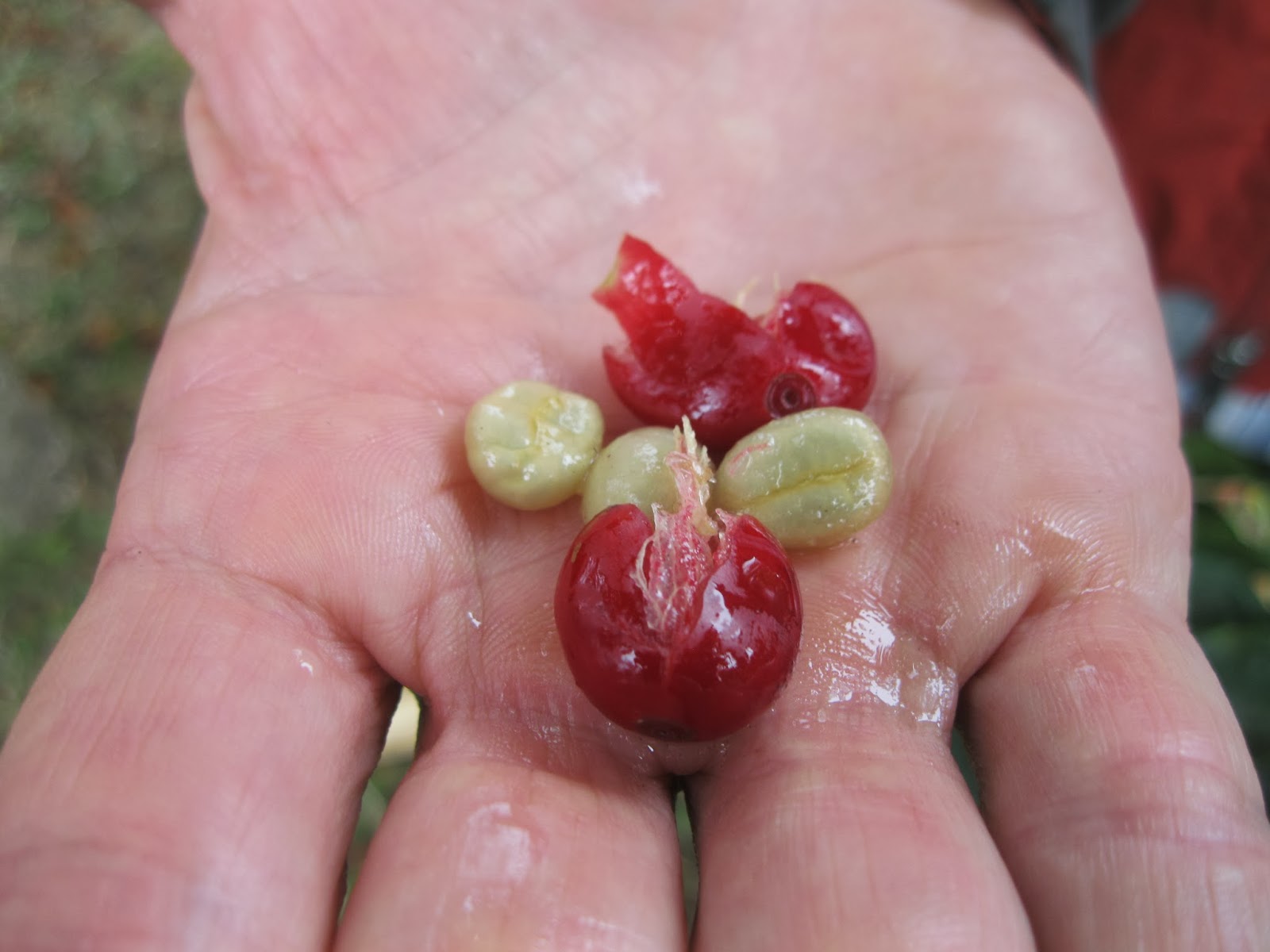
The coffee berries actually have a thin, sweet skin and pulp that must either be dried and pounded off (as Finca dos Jefes does) or soaked and worked off under water.  We learned that the former method is more expensive and takes longer, but the latter, which is usually employed, results in highly alkaline water being dumped in the nearby rivers and harming the plants and animals that rely on this water.
And there they are: coffee berries in all their glory.
 
The pulpy outside of the bean is surprisingly sweet.
 
 
Gary, the finca manager conducted our tour.  Here he's showing Jon the coffee on the drying tables.
 
Jon checking out the big mortar and pestle used to take the skins off instead of soaking the beans.

The dried, skinned beans are bagged and stored until it's time for roasting, which Finca dos Jefes does in small batches at high (400+ degrees F) temperatures. The roasted coffee can then be ground up and drunk -- either by "regular" consumers like us, or by "cuppers" who evaluate the taste, much like wine, detecting all kinds of flavors and undertones ranging from the pleasant (caramel) to the strange (tobacco anyone?) to the just plain yucky (mildew).  We tried our hands at cupping and learned that we should definitely not give up our day jobs when we guessed wrong even on the level of roast of the beans.  Still, for two individuals who are not big coffee drinkers it was great fun to learn new things about this commodity.  It's always good to learn about the things we consume, both to appreciate them better, and to become more discerning consumers who choose our products based on how ethically and sustainably they were produced.  Given that coffee is grown in dozens of countries around the world (though -- fun factoid -- Brazil is heads and shoulders the biggest producer), there are lots of opportunities when travelling internationally to visit a finca.  I'd recommend it for sure.

Friday, January 24, 2014

2. Go Rock Climbing Outside in a Foreign Country

Occasionally, a new thing makes the list as a way to fix a deficiency that's been bugging me, and that is the case with this one.  I've climbed outside before, and I've climbed in climbing gyms in foreign countries before (in Nepal and in Jordan).  But it's more than a little ridiculous that I've never been outside to rock climb, particularly during the almost-year I spent in Jordan.  So, when Jon and I decided to go to Panama as our new country choice to kick off the year, it was selected in part because it has outdoor rock climbing (and at least according to the all-knowing Internet world, Nicaragua does not).
Jon and me posing at the end of the day in front of one of many carvings done by a local artists (and in front of the cliff we'd been hanging off of for the last few hours).

There's a bunch of other climbing-related New Things on the list, but most of those will require actual work to progress from where I'm currently at.  This one was just fun.  As I mentioned in the previous post, Jon and I both thought that Boquete was our favorite of the places we visited in Panama and the fact that they had not only rock climbing, but climbing on really memorably-shaped rock, helped seal the deal on its "favorite status."
 
Me coming down off the "memorably shaped" basalt that made the day's climbing so interesting.

Lots of times I've found that the quality of a new experience (or even a not-new one) is determined as much by who else is participating as by what we are doing.  Our fellow climbers, two father-and-son sets (one son celebrating his college graduation, the other barely started in elementary school) and a newlywed couple on their honeymoon, varied widely in their skill level but shared a common sense of fun and appreciation for what we were doing. 
Favia was one-half of the newlywed couple (Brian was on the ground below).  She was the only one of us who did lead climbing that day -- here she is, making it look a lot easier than it is.

We were all also tremendously lucky to have the founder of rock climbing in Panama leading our experience.  Cesar is not only the best climber in the country, he's the person who started the sport there, and set all the routes.  Although his demeanor is very low-key and modest, at the end of the day, when he cleaned the routes at the end of the day by free-climbing them in a very rapid succession, it was like watching a professional acrobat at work.
When Cesar took down the ropes for the day he did by free-climbing (attached to nothing).  It was a little nerve-wracking to watch, though he never seemed to skip a beat.

I still have lots of limitations as a climber, which dictated that we climbed in the easiest area, called Gunko.  But the rock, which had a strange shape -- kind of as if square and rectangle blocks had been stacked with the corners sticking out -- made the whole experience novel and fun.  As did the knowledge that we were climbing on the first-of-their-kind routes for the country. 

In Boquete, some people talk about the fear that too many foreigners may find out about what a great place it is, and overwhelm it.  But I kind of hope that at least a small stream of rock climbers will hear about the climbing and come check it out. Given the natural beauty of the setting, the uniqueness of the basalt rock, and the enthusiasm of the tiny climbing community and its leader, Cesar, my bet is that they wouldn't regret the decision (and to learn more about him. his climbing, and how he got things started in Panama, check out this video.  For me, it was a great way to crack open the sport activity side of the 2014 list of 52 more new things.
 
 
One last shot -- this one of Jon, doing some tricky moves with his feet on that stack-of-blocks basalt rock.


Sunday, January 19, 2014

1. New Country for a New List for a New Year: Visit Panama


Back in 2010 when I embarked on the original year of new things I did it by travelling to a new country, Nepal, to visit my old friend, Cliff, and his family.  It was a great adventure to start the year, and I’m happy that I am also able to begin the 2014 year of MORE new things by also visiting a new country.  This time, though, I didn’t travel solo and I didn’t go halfway around the world.  Jon has (mostly enthusiastically) agreed to do lots of the things on my list with me, beginning with this visit to a country in our own hemisphere that is new to both of us, Panama.

Though we didn’t plan it that way, we actually managed to miss a truly frigid cold snap (even for Vermont) while we’ve been away, and spent the last eight days enjoying the warmth and rain forests of Panama.  Panama isn’t a big country, with a population around 4 million people, but it sits at a terrific intersection of things that Jon and I can talk about for hours – politics (me), the natural world (Jon) and geography (both of us).  Panama features a super-narrow natural “waistline” that became the Panama Canal to form a water shortcut between the Pacific and Atlantic Oceans; a huge diversity of animal and plant life and micro climates; a large population of indigenous people asserting their cultural and political autonomy; and a history of a small nation struggling to carve its own destiny under the weight of the larger and more powerful nations of first Spain, then Columbia and the United States.  Dipping into this fascinating mix of people, animals and history for such a short period, we concentrated our time in steaming Panama City and the cooler highland rain forest of Boquete – with an obligatory beach day to allow us to get the requisite Gringo sunburn to bring back to Vermont.


Jon and me exploring the town of Boquete, which also happens to have some spectacular gardens.
We started and ended the trip in Panama City, spending a couple days in the city and the adjacent Canal Zone on each end, and the middle was spent in Boquete.  Getting to Boquete requires a 7-8 hour bus trip (we took a night bus the first time, a day bus the second) from Panama City to David, Panama’s second largest city.  From David, it’s a one-ish hour bus ride to Boquete.

The Purple House Hostel in David took its title very literally.  The walls, linens, plates, everything --purple.  Here we preparing for our beach day where, because of my poor tanning application skills, I broke the color code and created some big blotches of red all over my shoulders.
The feature that dominates Panama City and the zone around it is overwhelmingly the Panama Canal.  Built between 1904– and 1914 by the United States, which laid claim to the land through the Hay-Bunau-Varilla treaty, after a failed construction attempt by the French, it was ceded back to Panama in the 1970s and actually reverted to Panamanian control on December 31, 1999.    There are plans, overwhelmingly supported by the citizens in a national referendum, to expand the Canal, and Panama views it as a key to its economic future.  The three sets of locks through which boats must pass in their 80 kilometer journey are impressive engineering-wise, but not much to look at.  When tourists are done watching the water move big boats up and down, their best bet is to do what we did, and retreat to the Casco Viejo, the section of the city that is full of old Spanish colonial architecture and is coming back as an artist-tourist district after crumbling into disrepair.
Although they're not exactly pretty, it's hard not to be impressed by the operations at the Miraflores Locks.  The ships are pulled by overland caterpillar type "tugs" with super-strong cables  and they have only TWO FEET of clearance on each side of the canal.  You can sit in stadium-style seating and watch the ships get pulled through as the Locks raise and lower.

Inside the National Theater in Casco Viejo.  Breathtakingly ornate, it feels like stepping into a bygone era of opulence.
 
 
Inside the Iglesia de San Jose, where the priests outwitted the infamous Captain Morgan when he came a-plundering.  While he was busy pulling all the riches out of the other cathedrals, the priests painted the altar black -- he thought the golden alter had already been stolen, and so he didn't take it, and a reproduction remains in the church to this day (the real one is in a museum).

Our other strong recommendation is to head to Boquete, as we did. Though a country with coasts, in addition to tropical islands, on both the Atlantic and Pacific Oceans might seem to be just begging for a beach vacation, anyone with an interest in wildlife, rain forests and hiking should seriously consider Boquete.  We were there for four days, stayed at one of the best hostels I’ve ever visited, and got the chance to go rock climbing, see a coffee plantation (finca), learn about the indigenous people of the area (the Ngobe-Bugle), and did some hiking with a local naturalist. Since the first two of these activities – rock climbing outdoors in a foreign country and learning about coffee in a finca, constituted new things, they will get their very own later posts. 
Jon gets the scoop on some local birds from Hans, our guide, who took us for a hike on a trail that is frequently used by the local Ngobe-Bugle Indians.

The takeaway message for travel enthusiasts is that Panama is a great destination.  In addition to the basic craven desire to escape the ridiculously cold weather being endured by our fellow Vermonters, we got a chance to see some beautiful rain forests, a bit of beach time, a marvel of the modern world, and a fascinating living lesson on the forces of globalization, and how they affect global sea trade, indigenous peoples and post-colonial states.  A great way to start a new year, and a new list.

My favorite "what is that" picture from the trip.  It's a giant fiddlehead from a tree fern.  There were lots of them in the rain forest we visited.

The hostel where we stayed in Boquete -- the Refugio del Rio was pretty great. It sat next to a river, had porches behind every room, lots of great common areas, and the most active kitchen I've ever seen in a hostel.  If you go to Boquete -- and you should -- consider staying there!

Sunday, January 12, 2014

One Last Challenge from 2013: The Streak


In late November, when I was starting to think about my list of new things for 2014 Jon made a suggestion for a challenge that he had just read about in a running magazine – a streak.  Unlike the seventies-style run with no clothes, this streak is about running for an uninterrupted number of days: the Runner’s World article advocated running without missing a day from Thanksgiving through the New Year.  Since Thanksgiving had already passed when Jon made the suggestion that was out, but the idea of running every day for a whole month definitely appealed.  I was tossing around putting it on the New Things list when a high school friend, Brad, posted on Facebook that he was about to finish his own November running challenge, the drive for 75, wherein he ran a minimum of 75 miles in the month.  He noted that he was looking for a new challenge, and I suggested this one.  Then I posted on my own Facebook page that I wanted to do a streak – running a minimum of one mile every day without interruption in the month of December, and asked who was up to join. 

We started as six, but one member, Anna, who lives in Tacoma, Washington, had a few too many family responsibilities during the month to keep her running uninterrupted.  That left five of us, three Vermonters and two in the Pacific Northwest.  On the Vermont side, I represented Burlington, and there were two Montpelier-ites, Jon and my ice skating friend Liz. The westerners were both friends from my high school days in Twin Falls, Idaho.  Claudine lives in Seattle now, and Brad lives near Boise.
Claudine joined the streak in part to get back into running regularly.  Here she is with her mom, Linda, (my ninth grade French teacher) after doing the 2009 Danskin triathlon
 
Jon and me at the Burlington City Marathon (my first, his fourth) last May.
 
 
Brad has done the Hood to Coast relay run in Oregon for many years.  Here he is with his team, squatting under the Saloon sign.
 
 
Liz is an athlete on several fronts, including figure skating.  Here she is in her solo performance at a local ice show midway through our December streak. 
  
Turns out that Facebook is a fine way for runners separated by thousands of miles to hold each other accountable to a challenge like the streak. The rules were very simple: each participant had to run for at least a mile every day from December 1 to the 31 without missing a day.  And all five of us did that, and reported in each day via Facebook to the others in the group.

Certainly, some days were harder than others, and though most of us sprinkled some 8-12 mile long runs in the mix, all of us “used” our one-mile minimum days on multiple occasions.  But we all also discovered that running a mile or two is actually a very doable thing to squeeze into a particularly busy day, at say, 5 am or after dinner, when we don’t usually think about exercising.

Some runs were particularly memorable.  Jon and I began our streak running a 5K fun run in Burlington in Santa suits with our friend Lynn, and Claudine wrote about a lovely 2.8 mile loop around Green Lake at night on Day 14 during the Festival of Lights there, amid a musical performance, luminarias lighting the path, and many people out walking while she ran. Brad wrote about his last run of the streak – going into it expecting to have a minimal, half-hearted experience and pulling out a 4 mile interval speed workout instead. Liz was universally acclaimed by the group – twice actually – for doing one-milers in boots and her winter coat with her dog in freezing weather outside on two different days when she didn’t have her running clothes on hand.
 

All of us had days were we reported that, absent the streak, we would definitely not have made it out the door.  December is a particularly challenging month for consistent exercise, between holiday socializing, travel and bad weather. We ran through sleet and snow and ice storms, and made use of indoor treadmills, neoprene sleeves, pet dog running companions, and bike-riding children shouting encouragement. All of us did out-of-state travel during the streak, yet everyone got in their runs, even on travel days.  In fact, one of the most interesting things several of us noted was that, once the decision of whether to run was out of the equation, the mental energy that normally went into justifications for not running on a given day was converted into problem-solving for how to fit a run into the day’s activities and circumstances.

When the streak ended on December 31, none of us tried to extend it into January.  But all of us talked about the lessons we’d learned – about how easy it actually is to incorporate a daily good habit with a bit of imagination and flexibility, about our own capacities, and perhaps especially about what a potent combination commitment and mutual accountability can be.  Ironically, I am the only person in our five streak team who has personally met all the other team members, and our running and communication happened, at different points by different people, in Washington, Oregon, Idaho, Vermont, Virginia and Florida.  But we made a promise to each other and we kept it, and all feel great about ending 2013 with this challenge.  To anyone looking for a great exercise challenge – that also happens to build both character and community along the way – I highly recommend putting together a streak team.   

 
Here are Jon and Lynn outside my place right before we headed down to join the throngs of other Santa's for the December 1 5K that started off the streak for Jon and me.

Friday, December 27, 2013

52 More New Things: The List

As most of my friends and family know, in 2010 I embarked on a project that I called 52 New Things.  Dreamed up with the help of my former students and good friends, Leah and Siham, the basic plan was to develop a list of new places, experiences and skills, and try them -- at the rate of at least one per week.  Throughout the year the list was a work in progress, with new ideas being generated by suggestions from Leah, Siham and other friends, and all of it catalogued on this blog (the creation of which was itself a new thing). 

The list included things I'd always wanted to try, activities that had always intimidated me, places that piqued my curiosity, and new twists on previous experiences. As the year progressed, I would post upcoming new things in advance so that friends could plan to participate.  I discovered resources all around me I had never known existed, like the Saint Michael's College Wilderness Program, and the many skills of colleagues, friends, and especially current and former students who became my teachers. It was an amazing year full of all kinds of adventures, new pastimes, new insights into myself and the world, and a strengthened network of new and old friends.

In 2011 I followed the year of new things with one of challenges, and then ten months of adventure in the Middle East (teaching for the University of Jordan), and finally in 2013 a year of 5 big challenges. I blogged about all of those too. They were all great, but there was something especially powerful about the year of 52 new things.  And so, for 2014 I decided I'd like to try it again.  This time around I'd like to change the focus a little.  I'm always up for travel, but I don't plan to do as much internationally (8 new countries that year) and hope to concentrate more on my own backyard (Vermont) and surrounding area (New York and New England).  In 2010 I tried many new sports (all things athletic have always been a major challenge for me), and was surprised at some of those I took to avidly.  Now, I'm excited not only to try to do some new physical activities that still elude me (like learning to do a headstand and later, a handstand), but also new twists on activities I now participate in regularly, like rock climbing and ice skating.  I also want to push myself to give back more this time, with some new volunteer activities on the list, and to explicitly organize more activities as group experiences, such as starting a book club.

So, keeping in mind that the list is always changing and evolving, here, decidedly not in chronological order, is the New Thing To Do List that I'll be bringing into 2014:

52 MORE New Things

In my Own Backyard
1. Hike some less-travelled Vermont trails. In 2010 and 2011 I did a lot of the classics.  This year I want to hit some of those I've never gotten to in over 15 years of living in the state.  Spruce Mountain, Jay Peak, Mount Pisgah, Killington and Belvidere are all potential candidates, but I'm very open to suggestions from more experienced hikers on this one.
2. Hike one of the Presidentials in New Hampshire.  Never done any of them; clearly this one is way overdue.
3. Hike any of the 40 High Peaks of the Adirondacks. Cascade is the only one I've ever done, so any of the others is a prime opportunity.
4. Do an overnight hike.  I've done lots of day hikes, but never one where I had to carry stuff up for a night on a mountain.
5. Hike the highest peaks of Northern New England and New York.  This one was suggested by my boyfriend, Jon, and sounds like a lot of fun, especially if I could coordinate it with some friends over a specified block of time. The only one I've done is Mount Mansfield (VT).  That leaves Mount Marcy (NY), Mount Washington (NH), Katahdin (ME) and Mount Greylock (MA).
6. Visit prominent historical sites in Vermont and the region. I'm especially interested in Eleanor Roosevelt's home called Val-kill in upstate New York, and also presidential sites/homes in Vermont, New Hampshire and Massachusetts.
7. Visit some legendary quirky places in Vermont.  First on the list is Dog Mountain and Dog Chapel in Saint Johnsbury, Vermont. I'm very open to more suggestions and co-conspirator offers on this one.
8. Canoe adventure on Lake Champlain.  Thanks to our friend, Lynn, I got to try canoe camping for the first time with Jon, Lynn, and Lynn's husband Ed, on the Green River Reservoir.  But Jon suggested a similar adventure on Lake Champlain and I'd love to try it.
9. Enjoy a winter sauna.  When she learned of the list, our friend Sharon offered up their outdoor sauna as a new experience.  Somehow, I always think of Finland when I think of winter saunas, but then again, winters in Vermont and in Finland are not really very different.
10. Take a moonlight cross country ski.  My former student and current friend, Michelle, suggested this one, and offered to join me, so it's definitely one I'm looking forward to on the list.

Further Afield
11. Panama. Jon and I will be starting 2014 in a new country for both of us -- Panama!  Looking forward to seeing the canal, doing some hiking and rock climbing, hitting the beach, and hopefully meeting up with some pretty birds and slow sloths.
12. Tanzania. We're also planning to go to Tanzania in late May.  I've been a number of times before, so will need to think of some new ways to experience this awesome country.
13. Eastern Europe?  Don't know if it will happen in 2014, but it's been on my list forever.  It's hard for me to imagine a new country I wouldn't want to visit, so I'm pretty open to any other travel opportunities that come my way in 2014.

Fear Factor
14. Dancing. In 2010 my friend Crystal and I took a semester-long beginning ballet class that intimidated me about as much as anything on my list, but turned out to be a great experience.  I am, however, still a terrible dancer.  My friend David has offered to give me some instruction in swing dancing and I'd like to (sort of) give it a try.
15. Introductory lessons on a musical instrument. I pretty much have no musical knowledge or ability at all.  But I'd love to at least try a little. My friend Julia has offered to give me a few piano lessons, and another friend, Michelle is thinking of trying guitar and invited me to give it a shot as well. One way or another, this may be the year to attempt it.
16. Bike and/or car mechanics. During the year of 52 my friend Nigel taught me to change both a bike and car tire, but I am sad to report, neither skill "stuck". This would be an excellent time for a do-over.
17. Things with tools. Truth is, they intimidate me a lot.  I am always sure I will break something, injure myself and/or make a general mess of everything.  But I do have at least two excellent role models on this one.  Jon is a carpenter, and is willing to teach me how to use some power tools, and Lynn, among other skills, totally knows her way around a chain saw for her conservation job. I hope to take up both their suggestions and offers of help in the coming year.
18. Mountain biking. This one is filled with visions of going over handlebars and broken collarbones, but this may be the year I finally give it a try.
19. Back country skiing.  This one combines the fear of falling/injury with my fear of activities requiring a high degree of athleticism.  With such a high intimidation factor, it's a good candidate for this year.

Volunteering
20. Animal shelter. A terrible thing that happened in 2013 was the death of my wonderful and beloved kitty, Peanut. I still miss her very much.  Though I have no desire to replace her with another animal friend, I think it would be great to volunteer with some cats and dogs awaiting their new homes.
21. Nature/Trail work. The year of 52 got me outdoors and I've been playing there ever since. It also gave me an appreciation for the work of people who maintain the trails and natural spaces we enjoy.  This year I want to give back a little. Lynn, who works at the Nature Conservancy has offered to help make it so, and I hope I'll be boundary marking, tree planting, trail maintaining and/or invasive species-pulling before 2014 is done.
22. Volunteering on a fun run. Last year when I ran the Burlington City Marathon (a very big first for me) I discovered what an enormous difference enthusiastic, supportive volunteers made.  This year I want to return the favor, and especially to be there for slower runners like me, for whom battling self-consciousness of our pace is as daunting as the run itself.
23. Bread and Puppet. One of my favorite Vermont events is the end-of-the summer annual Bread and Puppet show season in Glover, Vermont.  This will be the 50th anniversary year, and my friend Paul suggested this one for the list.  It's pretty far away, so I don't know if I can make it happen, but I'm definitely open to exploring the possibility, especially if I can find some friends to join me!
24. Baked Love.  I actually stole the name from a volunteer group at my school, Saint Michael's College, because I think it's so clever.  But the thought has recently occurred to me that I have never cooked as a volunteer, though my community is full of opportunities to help make, serve and/or share a meal. This year I will.

Better, Harder, Faster
This is a new category for this year's list. Here, I'm hoping to reach new levels on things I've started during or since the 2010 Year of 52.
25. Consecutive forward outside and inside 3-turns.  These are one-footed direction-changing ice skating turns.  I can do ones on an outside edge, but inside is much harder, and linking them harder still.  This year, I master them.
26. One foot spin. I can spin on two feet, but still have tons of work to get to one.  I will in 2014, though.
27. Ice dance. I'm envious of my friends in my early-Wednesday morning figure skating class who also have ice dance moves in their skill set.  This year I am going to take some lessons and learn some, too.
28. Solo or ice dance program. One of my favorite things I did this year was my first-ever ice show performance with six of the other Ladies of Leddy.  Next year, I definitely want to do another, but I want to take it one step further, as some of them have, and do a 90-second solo or ice dance performance as well.
29. 5K in under 30 minutes. As a slow runner, I am in the "run to complete, not to compete" category. But I'd like to have goals to work towards, and since I haven't run a 5k in under 30 minutes since high school, this year I will work towards it.
30. Half marathon in under 2:20. Same idea here.  I think I will try to do it with the unplugged half here in Burlington in early April.  If any friends out there want to train in tandem for this, please let me know!
31. Try trail running. Jon is a big trail runner, but I tend to spend my life searching out the flattest, smoothest terrain possible.  This year, though, I want to challenge myself and get some tutoring from him on this one.
32. Midnight run. One thing I learned in the year of 52 is that some of the greatest new activities are actually old ones, done new ways. Jon suggested this one, and I'd love to give it a shot, especially with someone else, or a small group.
33. Long distance team relay. Jon, and a number of my other friends have participated in long (100 miles or more) relay events completed by groups of friends.  If I could find a group of friends not worried about the overall time of the group, this would be fun to organize and participate in.  Maybe the Vermont 100 on 100, as Jon has suggested.  Anyone?
34. Sport lead climb at 5.6 or higher.  In 2013 I completed my first-ever lead climb, which was very exciting, at Rumney in New Hampshire under the instruction of the Wilderness Program.  It was a very easy route.  Now I need to learn to do it on some slightly more difficult routes.
35. Do a trad lead climb. Although lead climbing with bolts (sport climbing) is harder than top roping (hanging from a rope anchored at the top of the route), using traditional gear to anchor yourself as you go (trad climbing) is harder still, and I haven't done it. Yet.
36. Boulder a V2 route. Challenging as I find rock climbing, I think bouldering is even harder (and scary besides).  This one may be beyond me, but I think it's good to throw in some really hard aspirational stuff to shoot for.
37. and 38.  Two yoga challenges: crow pose and a headstand.  Can't do either, but this year I will work on both.  My friend Sharon, who is a yoga instructor, has offered to help me with the latter and in exchange I will teach her to ice skate backwards, which is on her list for the coming year.
39. Touch my toes. Here's how inflexible I am: I have never (at least as an adult) been able to touch my toes.  It's always driven me crazy, and this year I am going to get at least that flexible, or give it my best shot trying.

Brand new skills
40. Archery. Yet another of my friend Lynn's unusual talents is archery.  I've never shot a bow, but she's offered to give me a lesson.
41. Do a handstand. If I can pull off a headstand, this one would be next.
42. Organize and run a book club. Bunches of friends have expressed interest in this one, so I think I just have to show some follow-through.
43. Extempo story telling. There's this great monthly storytelling competition called Extempo that moves around the state.  My friend Kate has competed (and placed second in it) and before the year is over I will try it, too.
44. Acrobat/trapeze lessons. Jon and Lynn are both on fire to try this, and I think I am game.
45. Nordic skating. This is one I cannot wait to try!  It involves skating on extra-long blades outdoors.  I want to go to Lake Morey here in Vermont and try it on their 4.5 mile track.
46. Soap making. Suggested by my excellent friend and climbing buddy, Amanda,  I'm still up for it if she is.
47. Pottery. My friend Julia suggested this in the last year of 52, and offered to teach me.  I didn't get to it, but this time I will.
48. Cut down a tree.  My friend Ed is willing to show me how and let me help do it. I think it sounds really interesting, and one thing I learned in the original year of 52 is that most skills like this are more complicated than they initially seem.
49. Paint a room. My friend Leah suggested this the first time around, and it's another one I never got to.  But this time Jon is willing to walk me through the process.
50. Knit mittens. Another one from the first go-around.  My sister Katrinka taught me and I made one, then forgot how to thumbs, so never did the other. Hopefully, second time is the charm.
51. Silent retreat. Suggested by my sister Katrinka and several others, I'd like to try this potentially coupled with some mindfulness training.
52. Preserving food. When I was a kid, I helped with canning jam and pickles and all kinds of fruits and veggies.  But now I have no recollection of how it's done and would love to learn again.

So, there it is.  There will definitely be additions and subtractions as the year progresses, and I'll probably also incorporate a practice from 2010 suggested by Kathy, my brother-in-law's step mom, to also record "serendipity" experiences that arise as the year progresses. A major key to the fun of the list last time around was all the participation by the people in my life, so I'm inviting everyone to please take a look, make their own lists, and see what they'd like to do, learn and experience together.  Here's to a great 2014!