Showing posts with label Chris. Show all posts

Saturday, December 31, 2011

Jordan Challenge #23: Cross the Border with Chris

Before the year ends, I wanted to post one last challenge that I completed with Chris while he was visiting in November.  This one turned out to take some doing, mainly because of forces beyond our control.  When I asked Chris what he wanted to see before he got here, he suggested Israel and the West Bank, and Jerusalem in particular.  On a map, that looks like a fairly simple undertaking. The distance from Amman, where I live, to Jerusalem is only 44 miles.  But it requires a bus or cab from Amman to the border (known as the King Hussein Bridge on the Jordan side and the Allenby Bridge on the Palestinian/Israeli side), a different bus that goes through the no-man's land between the Jordanian and Israeli border stations, a third bus or cab once processed on the Palestinian/Israeli side, multiple checkpoints on both sides, and searching of luggage and passport handling on both sides.  So, though the distance is short, the process is not.

And everything gets more complicated still when you're in the position I was at the time, of applying for my residence permit and fearing that my passport might get called for at any moment by the immigration people here for processing.  But as always, Fulbright staffer and miracle worker Iman came through, made many calls to various offices on my behalf, and determined that I'd be able to make my way over without endangering my application process here.  So, on Thanksgiving Day (the morning after our stuff-ourselves-silly Fulbright Thanksgiving Dinner), Chris and I packed our backpacks and headed over.

Once we arrived we set ourselves at the very spartan but awesomely-located Palm Hostel in East Jerusalem almost directly across from Damascus Gate.  For those who have never visited the city, a huge proportion of what draws tourists and religious pilgrims of all persuasions lies behind the walls of the Old City, which is famously divided into Muslim, Jewish, Christian and Armenian quarters.  Most of the Gates (and there are 11 total, though only 7 are open) enter into very complicated narrow streets that feel more like tunnels in parts, lined with shops, restaurants and holy sites.  Inside the Walls are, among other attractions, the Temple Mount (Sacred to Jews, Christians and Muslims as the place where Abraham offered his son Isaac in sacrifice (though God did not make him go through with it) including the Dome of the Rock where the sacrifice was prepared and also where Muslims believe that Mohammad ascended into Heaven), the Western Wall (also known as the Wailing Wall -- where Jews go to mourn that destruction of the sacred Second Temple), the Via Dolorosa (Way of Sorrows) where Christians believe Jesus carried the cross to his crucifixion, and several churches, including the gigantic Church of the Holy Sepulchre, built on the spot where Christians believe Jesus was crucified.  One of the most interesting bits for me about this church is that parts of it are claimed by, among others, Catholic, Greek Orthodox, Ethiopian and Egyptian Coptic Christians, and so the keys have been entrusted to a Muslim family to keep the peace among all the sects. For a direction-challenged person like myself, it's all crammed confusingly close together and it's incredibly easy to get lost in the narrow passageways.
Approaching the Old City from the West Jerusalem side.

Chris standing in front of the Western Wall.  Though we visited it at night, there were hundreds of people there.

Standing within the Jewish Quarter of the Old City.

One of the cool things you can do inside the Old City is climb up on the rooftops near the Church of the Holy Sepulchre and look at the Dome of the Rock.  That's how this picture was taken.
Monks chanting a prayer inside the Church of the Holy Sepulchre.

The view of East Jerusalem as you exit from Damascus Gate.

While we were up on the rooftops, Chris made a friend.  She made him sit there for about an hour, and if she'd had her way, we'd still be sitting there.


As it turns out, getting lost was actually a good thing, because it opened the way to a thoroughly wonderful experience.  On our first night, I managed to get totally disoriented and a man passing by had a fun time watching Chris and I disagree about where to turn next.  When we finally made our way out through Damascus Gate, he approached us and fave me a good-natured ribbing about my mistakes.  This led to a longer conversation, which in turn led to what I have found to be a typically Palestinian response to strangers, a sincere and hospitable offer to come over to dinner.  We accepted, and spent the evening at the home of Mohammad and his wife Yusra, after Mohammad gave us a tour of his community, the homes of his extended family, and the difficult changes that had occurred there since he was a child. Both Mohammad and Yusra had lived large chunks of their lives in the United States with other spouses, and had many interesting stories from those experiences.  Mohammad had gone to college in the US and created a successful business there, while Yusra had married as a teenager and accompanied her husband to the US, where her husband died and she found herself suddenly coping with the challenge of raising four children as a single parent in a foreign country.  However, both Mohammad and Yusra have deep family ties in East Jerusalem, and returned in part to help resist the shrinking of Palestinian control and ownership of land in East Jerusalem that has steadily eroded the community there. It was an amazing experience to share the lives of two of such wonderfully generous people who decided on a whim to open up their home to us.

Yusra and I (with the very few of the fabulous stuffed grape leaves we couldn't  eat sitting on the table behind us)

Among other things, Mohammad and Yusra served us clementines off their own tree.  We were raving about how good they were, so they sent us home with some that Chris and Mohammad picked.

From Jerusalem, we took a bus to Tel Aviv which is situated right on the Mediterranean Ocean.  Our timing was less-than-perfect, however.  It was November, and too cold for swimming (unless you were a surfer or diver with a wet suit and we saw quite a few). We also arrived on a Friday afternoon, and at sundown, the beginning of the Jewish Sabbath, the outdoor market where we were haggling over dried fruit suddenly shut down in a hurry.  We wound up staying a few kilometers down the coast in the lovely seaside town of Jaffa and spent a day or so exploring both places.
A view of Tel Aviv from the beach...

..and at night.

And a night-time shot of Jaffa, just a couple pleasant kilometer's walk along the seashore.

Then we headed back to Jerusalem, and ultimately, across the River Jordan (which is not, as the bible hymn says, "deep and wide", but actually has been overused to the point that it now most resembles a muddy ditch) to seek out a few more sights for Chris to see before he headed back to Vermont.


Friday, December 2, 2011

Jordan Challenge 18: Check Out the Madaba Mosaics

From a tourist perspective, the town of Madaba only some 30 kilometers from Amman, is essentially Mosaic Land.  Everyone goes to see the famous remains of the mosaic map of a big chunk of the Middle East -- at least as it was envisioned in 560 A.D.  Much of the map, which sits on the floor in front of the altar of the Saint George Church, is still quite discernible, and every day tour buses deposit their human contents at the gates of the church to check it out before moving on to the Dead Sea and Mount Nebo (where Moses is believed to have died -- at the ripe old age of 120).  But the tourists do themselves a disservice because Madaba is a lot more than a mosaic map.  For starters, the map may be the most famous, but it is just the beginning of the mosaics to be viewed.  Where other churches have paintings and stained glass, St. George's is chock full of mosaic scenes from the New and Old Testaments of the Bible, as well as various saints including, of course, the church's namesake.


Here's a portion of the map that is still quite well-preserved...
...and here it is "in context" on the floor of the church.  I had to examine the other art closely to realize that all the other representations are also mosaics.
And here's Chris standing next to the map diagram outside the church that helps make sense of the mosaic inside.

Of course, there needs to be a mosaic of the church's namesake, St. George, carrying on with his slaying duties.

When I was a kid I liked the story of raising Lazarus from the dead, and as an adult AIDS activist I am always reminded of the modern "Lazarus effect" that African activists talked about when anti-retroviral medication finally arrived and started bringing people who were expected to die back to good health and vitality.
There is also a modern-day mosaic art industry and several other churches with their own treasure troves of mosaics, which leads to another Fun Fact About Madaba.  In a country that is overwhelmingly Muslim, Madaba has a sizable Christian population, and just about every hotel in town is owned by a different Christian family group who will, if you are as lucky as we were, tell you all about the town and serve you up some delicious homemade fig jam at breakfast.

In addition to its mosaics -- old and new -- Madaba is also home to many rug weavers, and shops that sell their wonderful and colorful work.  It also boasts a sand artist who is simultaneously the fastest and the best artisan of those I have seen in Amman, Petra or Aqaba.  And it has lovely cafes and simple hole-in-wall shops that sell a very tasty and cheap dish of cut-up roasted chicken and shrek bread smeared with a vivid red sumac-based sauce.

Sadly, I lost the scrap of paper I used to write down this sand artist's name.  But I am certainly going to head back to his shop when I return to Madaba because he is amazing!
But I would say that Madaba's greatest commodity is actually its hospitable people.  In a country that rightly prides itself on hospitality, Madaba deserves special mention.  We arrived in the middle of a heavy rain that we'd been caught up in as we were hiking along the road from the Dead Sea in search of a vehicle to take us the rest of the way.  The cab driver who finally picked us up spoke almost no English and did not know his way around Madaba at all.  When he dropped us at the wrong traffic circle for the Black Iris, the hotel we were hoping to stay at the for the night, a small group of men gathered in the rain to confer with us.  They quickly decided that the youngest, a teenager, should accompany us to the hotel to avoid any further problems.  He got us a cab, came with us and insisted on paying the driver.  Then he got out of the cab when we did, pointed out the hotel, welcomed us to Madaba and walked away in the rain after wishing us a great time in his town and refusing to take our money. From that auspicious beginning, we were treated to on-the-house teas, people who walked with us rather than simply pointing out the directions of destinations, and general friendliness everywhere.  No doubt about it, Madaba's got some great treasures on its walls and floors.  But the biggest ones are walking around in its streets. Not the flashiest of Jordan's tourist destinations, but surely in the running as the friendliest.

Wednesday, November 30, 2011

Jordan Challenge 17: Hold a Thanksgiving Dinner in Amman

Like floating in the Dead Sea, this one turned out to be no challenge at all, thanks to the concerted efforts of the Fulbright Commission staff, particularly Aya and Iman, who spent the weeks before relentlessly tracking down turkeys, missing RSVPs, and just the right combination of pot luck dishes. One of my favorite things about the Jordan Fulbright experience has been the opportunity to get to know so many of the people in our cohort.  They are quite the collection of talent and positive energy, and I always look forward to big get-togethers like this one to catch up and see how everyone is doing. In addition, since it was at the beginning of Chris's last week in the country, it was a chance to introduce him to some of my friends that he still hadn't met.

The amazing Iman -- social worker, problem solver, logistics miracle worker -- and party planner besides.  She's the best.
The Fulbright Commission has turned Thanksgiving dinner into an annual event (though we did celebrate it a day earlier than in the States), and provides the setting, three turkeys and some lovely pies.  We are responsible for the other dishes, with some guidance from Iman and Aya, who made sure we didn't wind up with ten cranberry sauces and no other side dishes. It was a great chance for people to show off their culinary skills, and once again, I was reminded that this is one pack of people who are as handy in the kitchen as they are with the Arabic alphabet. We all stuffed ourselves, then in good Jordanian fashion, had some more.
So much good food, it was ridiculous.  Not that I'm complaining...

Of course, it wouldn't be Thanksgiving without some kind of drama, but ours was not of the family version.  Rather, the students (18 student researchers and 10 English teaching assistants (ETAs) -- or everyone but Tess, Angela and me) were all in the running for a trip to Morocco.  It turns out that the Fulbright Middle East Program holds a student conference hosted in two sites -- Jordan and Morocco.  Half the students in the region go to to one conference and half to the other, so half of each of our student groups would be staying for the Amman conference and the other half would be flying across North Africa to join the Morocco conference. So, as we all sat around in food comas, Alain, the Commission Executive Director, conducted a drawing to determine who would go and who would stay.  Everyone accepted the results with remarkable grace, leaving me to conclude that all bad news should be delivered to people who have already been stuffed with turkey and Tess's pecan pie.
Our dinner table group -- Jacqui, Tess, Elizabeth, Christina and I (minus Chris, who was taking the picture). I think Tess and I are doing a remarkable job of not looking covetously at the residence cards the others are flashing -- which we are still waiting for.

Chris and I feeling happy and very, very full.

After we had all left the dinner, one of the Fulbright ETAs, Jennifer, posted a lovely list of things she had to be thankful for this Thanksgiving, ending with Senator William Fulbright, the man who convinced his fellow Senators that his new idea for a global academic exchange could truly serve American interests around the world.

This is Jennifer, who I mentioned above, together with Daniel and Hannah.
Like Jen, I'm grateful for Senator Fulbright and his vision among the many other things I had to be thankful for this Thanksgiving 2011.

Monday, November 28, 2011

Jordan Challenge 16: Float on the Dead Sea...in the Rain

The whole point of the Dead Sea is that floating on it is absolutely no challenge at all.  The Dead Sea sits on the lowest area of the earth, and apparently, that makes the water evaporate at a rate faster than in any other body of water.  Added to that is the fact that the Jordan River that runs into it has practically entirely dried up through over usage, and you've got one very salty receding body of water.  That hasn't stopped resorts on both sides of it from building luxury hotels and spas along the edges, but luckily, a few years ago the city of Amman, some 60 kilometers away, created a public beach as a slightly more economical alternative for those who want to take a dip and be able to wash off the salt (which is nine times as concentrated as ocean salt), but still emerge with at least a little money in their wallets.  That beach was our stated destination when Chris and I did the next leg of our Discover Jordan Tour.

The plan was to spend the day at the Dead Sea (Chris was impervious to my warnings that, for most people, a bob about in the water is enough, then they're ready for something else) and the night and following day in the town of Madaba.  Everything was all set, but the weather just wouldn't cooperate.  I don't know if it's typical, but this past November Jordan has gotten entirely more rain than I would have expected in a desert nation.  And the day we hit the Dead Sea was no exception.

This is what the Dead Sea looks like on a very overcast late afternoon in November -- so funny that there's no flora or fauna in the water.
As far as Chris was concerned, though, it wasn't much of a problem.  For one thing, he has a passion for sliding on slick surfaces, and the tile surrounding the pool and dining area of Amman Beach definitely fit the classification of ultra-slick.

One of Chris's all-time favorite past-times -- sliding on slippery surfaces (while everyone around draws in their breath waiting for the fall that never happens).
And the nasty weather also scared off all but the most intrepid Scandinavian tourists (whom I'm guessing, like Vermonters, take pride in carrying on in bad weather).  So we had the beach mostly to ourselves, and performed the necessary tourist ritual of bobbing in the water, completely unable to sink, no matter what we tried.  The water is crystal clear because, except for brine shrimp, nothing -- no animals or vegetation -- can live in it.  The beach bottom is coated with a layer of crystallized salt, which is pretty to look at but harder to walk on.  And the water feels almost oily in its heaviness, though you know you're in it pretty quickly, when your skin starts to feel itchy and tight. 
Here I am doing the Dead Sea Float.  You pretty much have to float on your back because getting the water in your mouth, or worse, your eyes, is a terrible experience.

Chris cleverly brought a prop -- a Motor Trend magazine -- for his float.

We managed to outlast the rain, and when it finally grudgingly turned into a thin sprinkle, headed down to the water where Chris, I think, stayed in the water -- and marvelled at his transitory incredible floating abilities -- longer than any other swimmer (floater) that day.  I'd been once before with friends and former students Siham and Connor, and remember finding the whole thing a bit odd.  But it would certainly be a crime to come to Amman and not go.  Yet another unique experience for the books here in Jordan.

Sunday, November 27, 2011

Jordan Challenge 15: Learn about the Royal Family -- by Visiting their Cars

There's no question that Chris and I lucked out in terms of travel during his almost month-long visit.  We made the most of a month of weekends and were helped out by an extra-long holiday week to see all kinds of places.  But there's also always the unexpected bonus right in your own backyard, and one of our favorite little jaunts was the one we made to the Royal Automobile Museum.

The biggest challenge was figuring out how to get there.  The ubiquitous Lonely Planet guidebook that is constantly waved around by all ex-pats, including me, is both out of date and hopelessly vague in its instructions.  Directions to the museum are a case in point, "in the northwest suburbs of Amman, north of 8th Circle."   We finally resorted to the last-ditch of resort of choice -- hailing a cab, calling the destination, and when a person comes on the line, having that person feed directions to the cab driver (in Arabic, of course). 

Once we arrived we joined a few school groups of excited elementary school children in their uniforms filing past the cars.  And there were a ton of cars.  For me, it was a chance to learn about the Royal Family, and by proxy, the history of Jordan since the automobile.  Those not up on their Jordanian politics might not be aware that Jordan is actually the Hashemite Kingdom of Jordan -- that is, a monarchy.  The current king, Abdullah II and his venerable father before him, King Hussein, are/were both huge car enthusiasts.  They shared a love of fast vehicles, and were both accomplished pilots and road rally drivers. I was, however, disappointed that the most famous car that features in the legends about King Hussein, a taxi, was not there. Even now, more than a decade after his death, King Hussein remains a larger-than-life figure, and one of the many stories about him and his amazing common touch is the "taxi story".  According to many people I've met here, the king had his own taxi, which he would occasionally disguise himself and drive in order to ask his subjects just what they thought of the king and how things were going.

My favorite car in the museum, because of the sheer novelty of it, was this Amphicar.  It could literally drive on water and the late King Hussein bought it in 1966 to take guests for "drives" in the Red Sea in Aqaba.


And my favorite picture in the museum was this one, also of the late King Hussein.  Here he is, every inch the carefree teenager, not knowing that the next day his grandfather, King Abdullah I would be assassinated, and he would become king at the age of 17.
I think for Chris it was also a chance to see some extremely fancy cars up close and personal. 

Until I went to the museum I did not know that such a thing as a Bugati Veyron existed, nor that it one of the fastest cars in the world...

...but Chris did.  Here he is in front of the Bugati and some other very fast toys in the royal collection/
But we both had a great time, and it was an excellent way to spend a morning in-between trips to more far-flung places.  If you like fast cars (like Chris) or you don't, but like modern history (like me) it's certainly worth the extra bit of effort it takes to figure out where it is.  I'd say go.

Sunday, November 20, 2011

Jordan Challenge 14. When in Jordan During Eid, Head to Aqaba

There's nothing like leaving your own culture to make you realize which cultural values are so deeply embedded that you don't even notice they are cultural values.  Being in the Middle East, like being in East Africa a few years ago, makes me acutely aware that I am an American who thinks about time the way an American does. For us, time is a commodity to be scheduled and once the schedule is in place (as far in advance as possible), to be adhered to as rigidly as possible.  Jordan's not like Tanzania, where a 6 pm dinner appointment might just as easily mean 7 or 8, but there is a certain fluidity to time here that is tough for a lot of Americans, including me, to acclimate to.  Some of it is fun, like the fact that waiters will NEVER kick you out of your table here, and you can sit for hours without ever being brought a check.  But other parts really challenge Americans to put their day planners away, because we can schedule till we're blue in the face, but things might change.  Religiously-based holidays, for instance, can only be estimated on the calendar and aren't actually fixed till a few days before the holiday based on where the moon is. This year, that turned out to be a bonus for everyone when Eid al-Adha -- a very big holiday in the Muslim calendar commemorating the end of the Haj and also God's relenting and allowing the prophet Abraham to sacrifice a sheep instead of his son -- happened to start on Sunday (which is the first day of the work week here). Then the powers that be announced we'd be having the whole week off for Eid. Bonus!

We had hoped to spend at least part of the Eid holiday visiting the West Bank and Israel, but that was not in the cards because I am still waiting for my Jordanian residence permit, making travel across the border quite tricky.  So, we decided to visit some places in Jordan, including first Petra and then Wadi Rum.  And Aqaba, it turns out, is only an hour's drive away from Wadi Rum and situated right on the Red Sea.  So of course, we decided to check it out as well. The only problem with our little plan is that it was shared by many Jordanians who were as excited about the week-long holiday as we were.  We found this out through experience, when, for instance,we showed up at the JETT bus station an hour early to get tickets to Aqaba, only to find the bus sold out.  No matter, we bought tickets for later in the day and luckily had thought to book a hotel room earlier.

Although Aqaba reminded us both of other seaside resorts we've been to, the beautiful mosques of Aqaba were part of what made it unique.
Chris and I both thought that Aqaba reminded us of Mexico, particularly the Baja coast, in terms of both weather and the general atmosphere.  Of course, Mexico has many fewer mosques and many more displays of skin among the beach goers, but still, after the rainy chill of Amman, the easygoing atmosphere was quite easy to take.  We sandwiched out trip to Wadi Rum in between two days and nights (at two different hotels) in Aqaba and managed to get both desert and beach sand all in one trip!
On our first night in town we took a stroll on the waterfront.  The lights behind Chris are of the much larger Israeli resort of Eilat across the water.

Here's where the Middle Eastern perspective on beach-going starts really diverging from ours.  The only people wearing swim suits on the public beach were little children and teenage guys.  As you can see with the woman sitting in the foreground, Jordanian woman pretty much stay fully clothed on beach days.

Chris enjoying a (non-alcoholic) drink at sun-down and taking in the terrific view.

We never made it down to the resorts south of town where the snorkelers and scuba divers explore what are supposed to be amazing coral reefs -- that will have to wait for another day.  But we can now say we've taken part in an important institution -- celebrating a part of the Eid vacation on the shores of the Red Sea the Jordanian way. 

Wednesday, November 16, 2011

Jordan Challenge 13: Roughing It in Wadi Rum

Change a few factors and a place you've already been can be a whole different experience.  Not exactly a startling revelation, but a true one, nevertheless.  Only a few weeks ago, I visited Wadi Rum for the first time ever with my good friend and fellow Fulbrighter, Elizabeth.  My second visit, this time with Chris -- who has been wonderful in so many ways, beginning with his willingness to take the plunge and come for nearly a month of whatever I had in store for him here in Jordan.  Unlike Elizabeth and I, revelling in our tent containing towels folded up like swans, Chris was interested in roughing it a bit, and our driver and guide, Salamah, was more than willing to accommodate.  From the truck we rode in, which Salamah reported was the same age as its twenty-five year old driver, to the night we spent under the stars -- no tent, no sleeping bags and no artificial light beyond Chris's headlamp and Salamah's tiny light on his cell phone.

The beige truck is Salamah's, and he's sitting patiently next to it, waiting for us to climb down and head to the next site.
We started out from Aqaba, with intentions to take a local minibus.  But alas, it was Friday morning, and no minibuses were going out, so we had to take a cab, with the driver insisting all along the way that we meet his "friend" who would take us to an undisclosed camp and some equally vague sites within Wadi Rum.  We opted for the Visitor's Center in Wadi Rum instead, to our driver's great disgust, and contracted with Salamah to take us out in his ancient truck to a whole range of sites.  Salamah was as good as his word and took us to, among others, the site of Lawrence of Arabia's home when he lived in Wadi Rum (the house is not there any more, though); Lawrence's Spring; the Red Dunes (which are just about the best workout I can think of as a climb.  I thought I might die slogging up them, but Chris, of course, sprinted to the top and then rolled back down, just for the fun of it); cliffs we could climb up to view Nabatean drawings; Jebel Khazali (a siq that you can climb through for about 150 meters);
The siq was pretty narrow in parts, and lots of fun to explore.
and (my favorite) Little and Big Bridges, two sandstone formations that have been carved by the wind to resemble rock bridges high off the ground). 

Here we are on top of the Red Dune -- after some strenuous effort to get there....

...and Chris rolling back down (rolling, that is, til he ran into the scrubby bush standing in front of him in this picture).

One of the great glories of Wadi Rum is the sand itself.  It's a uniform, beautiful orange-pink color, and guaranteed to bring out the inner child in anyone.  You can't help but run your fingers through it and start scheming about how to bring some home.
Big Bridge is also a good workout, but there's no motivation like having a Bedouin child fly past you on the ways up and down, as you're trying to negotiate the rock face.
Chris and I on top of Big Bridge...

and coming back down -- which is scarier than the uphill part.

Of course, Chris also needed to try out camel riding, so we did some of that before we began our tour, and about midway through the day Salamah made the suggestion that we not go to a camp in the evening. 
First stop on the tour: a couple kilometers on the back of a camel.

He offered to pick up some blankets and food, and set us up at a site in the desert instead.  We knew it would be a full moon that night, and the idea of sleeping directly under the stars with a minimum of gear, noise or other people had a lot of appeal.

Salamah made roasted chicken for dinner over the fire. Note the cell phone-as-flashlight function.
One thing we learned is that the Bedouin are quite social.  No sooner had Salamah lit our fire for the night when his friend and fellow driver/guide, Salaam showed up, and an hour later another friend, Khaled came as well.  They sat on the camp well into the evening, and when Salaam finally left he was so out of it that the next morning Salama realized he had taken one of Salamah's sandals and left one of his in its place.  Khaled decided to spend the night at the site as well, and slept in the bed of his truck.
Salamah's friend, Salaam, showing off his favorite cigarette brand in between extolling the virtues of the carefree Bedouin existence.

The next morning when I woke up, Chris was nowhere to be seen until I looked up.  In the wee hours of the morning he had woken up and hiked to the top of a sand dune with his cushion and blanket in order to sleep get a full view of the morning sunrise and early-morning creatures-- two and four-legged -- who would be out on the desert tracks below.  When we were all up, we gathered some more wood and Salamah brewed still more sweet tea and put some bread on the fire for a camp side breakfast before we broke things down and headed back to the main road to catch a local ride back to Aqaba.
Nothing looks quite as scruffy as a campsite the morning after sleeping around the fire, but it surely served us well.

An expression you hear a lot in Jordan is "as you like".  It can take on a whole range of meanings from "okay have it your way, but you're an idiot" (when, for example, you're about to foolishly disregard someone's obviously sound advise) to "whatever you want, but don't be stingy" (when a taxi driver doesn't turn on the meter and wants to guilt you into paying a generous fare). But in the case of Wadi Rum, I think it means that the choices you make, from which sites to visit, how you get there, and how many creature comforts you part with along the way, will have huge impacts on the experience. Roughing it in Wadi Rum left me with sore calf muscles, a lot of sand in my hair, and tons of great memories and images.  As experiences go, it's a winner.

Monday, November 14, 2011

Jordan Challenge 12.1: Petra by Night

So, Chris and I have returned from exploring the southern part of Jordan, which we broke into two trips.  First we went to Petra for a couple of days, then came back to Amman and restocked our cookie travel provisions, and then headed to Aqaba and Wadi Rum. All three places turned out to be unique travel experiences, so each will get its own posting, beginning with Petra (and I should note that if the photo quality of some of the shots is better than usual, it will be because I'm liberally borrowing from Chris's pictures).

When I put together the list of challenges for my Fulbright experience in Jordan, I envisioned Petra as the "Camel's Hump" of my Jordan experience.  For non-Vermonters, Camel's Hump is possibly the most well-known of our many day hikes in the state.  During my year of 52 New Things, I resolved to hike it in all four seasons, and had a great time seeing the mountain in different ways.  So, I thought I'd copy the idea with Petra, and think of ways I'd like to experience it that are a little different.  I came up with three: by night, in the winter, and in the company of an actual archaeological expert. So, I am happy to report that I am 1/3 of the way through my goal, having experienced Petra at night with Chris and several hundred other chattering tourists.
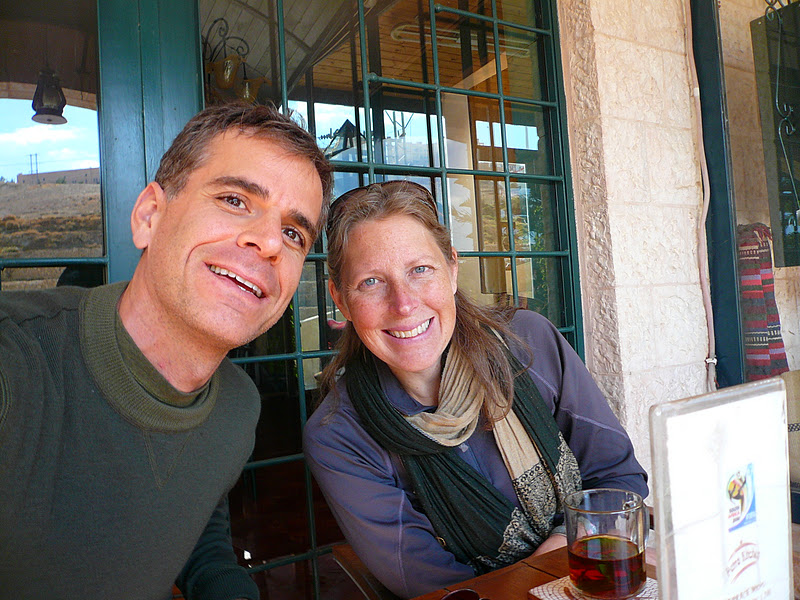
Chris and I having tea at Petra Kitchen in Wadi Musa before embarking on Day 1 of Petra explorations

Along the way, of course, we also did a lot of exploring of Petra by day and, since my camera was no match for night-time Petra, that's what most of the photos capture.  Anyone who's seen Indiana Jones and the Last Crusade has actually seen Petra, because there's a famous chase scene in the movie that was filmed there.  Petra is an ancient Nabatean town that was carved into the sandstone cliffs.  Westerners didn't know where it was until a Swiss explorer named Jean Louis Burkhardt tricked his way in in 1812, pretending he wanted to make a ceremonial sacrifice.
Here's Chris about to enter the Siq.

The way in is actually possibly the most awe-inspiring feature of the whole place.  You travel through a siq, which is an amazing canyon (except caused by tectonic shifting instead of water) that goes on for 1.2 kilometers.  In parts it's just wide enough for a horse-drawn carriage, which a few people use, and just when you start wondering how much longer it will be, it opens into a wide space and you face the most famous structure of Petra, the Treasury,
The view of the Treasury right at the end of the Siq right before heading into the open space directly in front of it...
...and the Treasury in all it's glory.

After the Treasury, there are miles of ruins, most incredibly well-preserved, for the exploring. After the Nabateans, Petra was used by the Romans and the early Christians and then, of course, the Bedouins, so there are all kinds of structures to be examined.  There is an ancient theatre, countless cave homes and tombs, a set of Royal Tombs, a high place of sacrifice, ruins of temples and churches, and, if you're feeling ambitious, 800 steps (950 according to the Bedouins trying to get you to hire a donkey) up, a Monastery.  The options are endless, which is why I advise people to do what we did, and buy a two-day ticket.
Here's Chris from a cliff overlooking the Monastery


At 8 pm on the night of the first day we showed up at the gates again, with several hundred other people, for our night-time experience.  The path to the Siq (about half a mile) and then the Siq itself, are lit with thousands of candles, and there are amazing shadows everywhere.  When everyone has filed through the Siq into the open space in front of the Treasury,the audience is seated on row after row of mats to watch a show of Bedouin music (and of course, the drinking of tea, because pretty much every event in Jordan involves the drinking of tea).  After the show, everyone files out again, though this time Chris had the brilliant idea of waiting out the crowd.  So, we climbed up on some higher rocks and watched the hundreds file through the path we had taken in, and then joined at the back to experience Petra at night more quietly.

The photo doesn't do it justice, but here are people filing through the Siq at night.
Though Petra at night was much more of a community affair than I had envisioned, I highly recommend it.  I've never seen anything like the Siq, and walking through it at night in candlelight and long shadows is an amazing visual and sensory experience. If you ask me, it's another one of those things that everyone must see at some point.